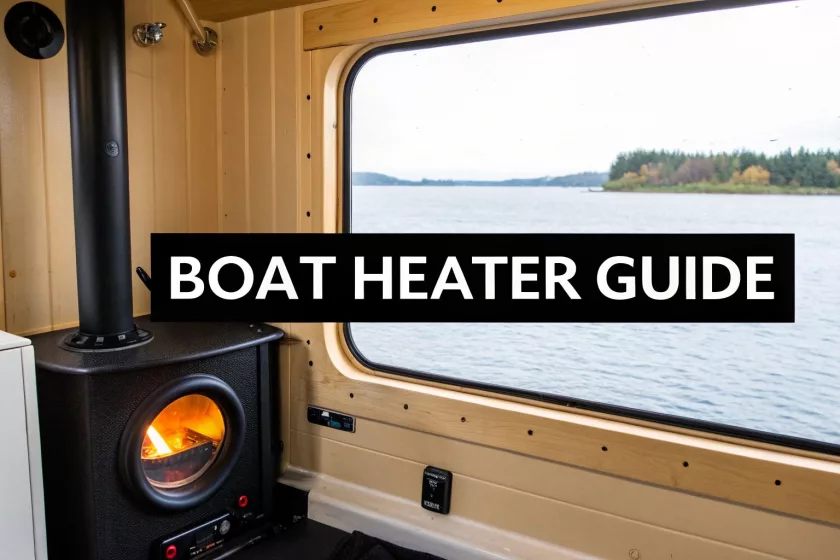
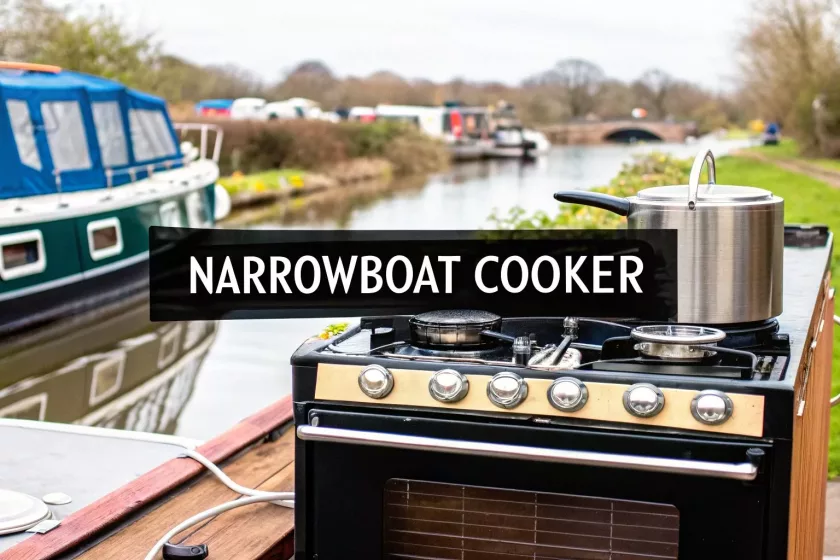
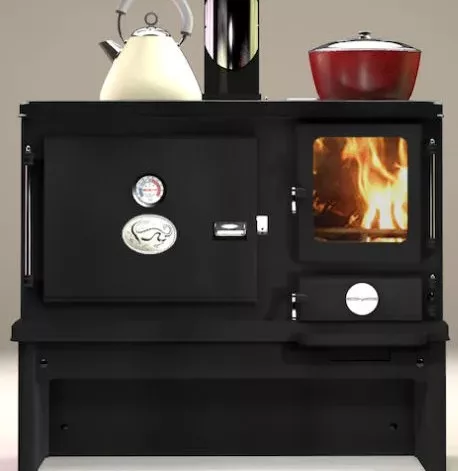
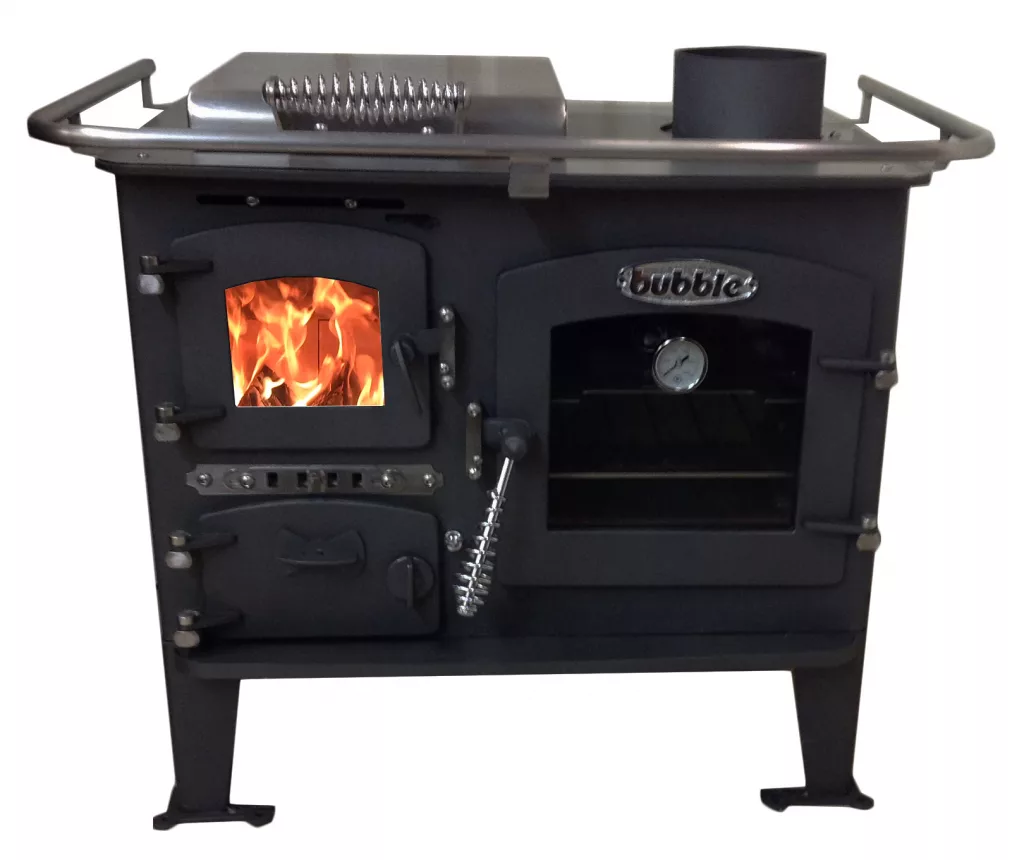
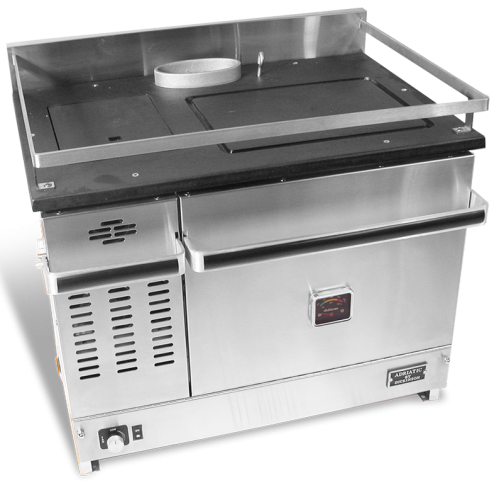
Welcome to our Boat Heating and Cooking category page, your go-to resource for marine appliances designed to enhance your boating experience. We offer a comprehensive selection of LPG, Diesel, and Solid Fuel heaters and cookers tailored to meet the unique demands of nautical life. Whether you’re seeking efficient heating solutions for chilly nights on the water or versatile cooking options for your galley, our collection is curated to provide you with the highest quality equipment and the latest technology.
In this section, you’ll find valuable information about the advantages and disadvantages of various fuels used for cooking and heating on boats. Each fuel type has its own characteristics that cater to different needs and preferences. For more in-depth insights, check out the links below to explore our Diesel Heaters and Cookers, LPG/Gas Heaters and Cookers, and Solid Fuel Heaters and Cookers. With our robustly built marine appliances, you can enjoy comfort and convenience no matter where your adventures take you.
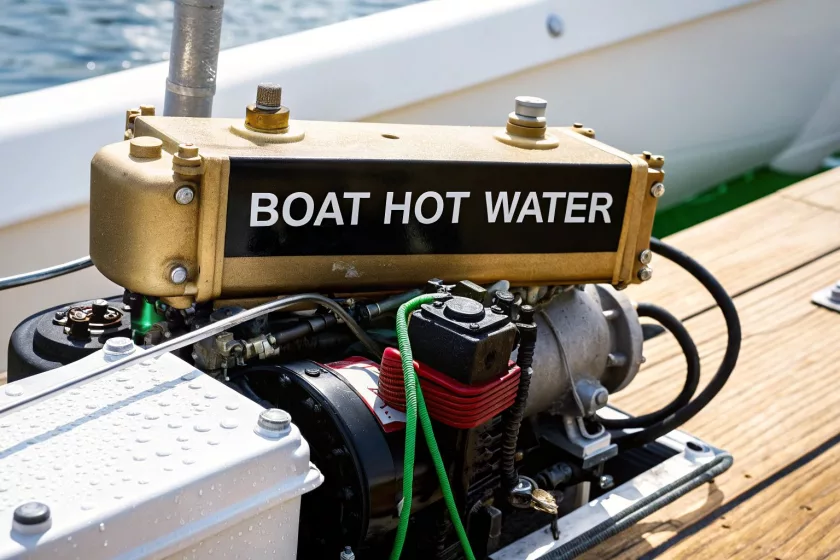
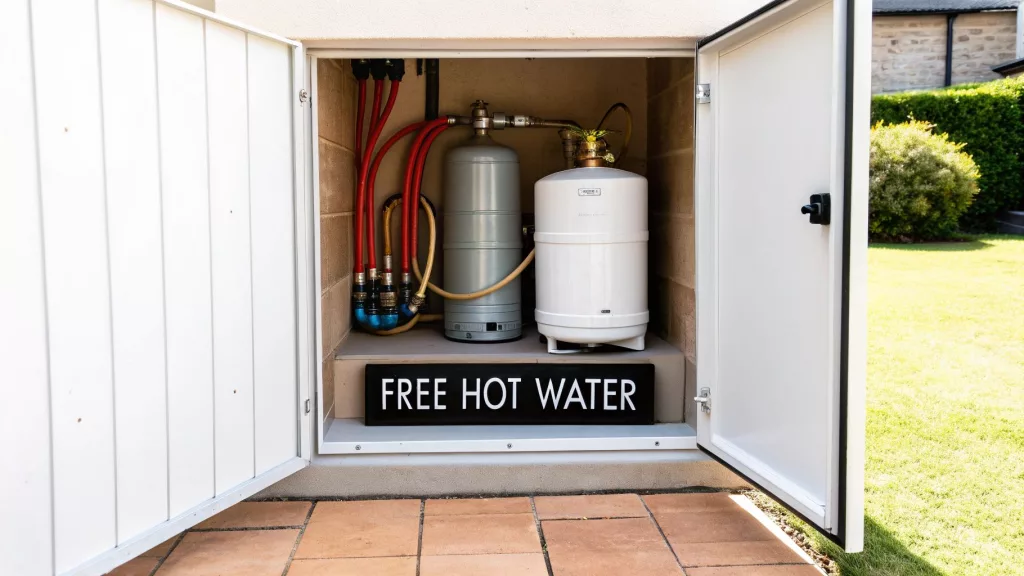
A calorifier water heater is a brilliantly simple bit of kit for any boat. Essentially, it’s a super-insulated hot water tank that cleverly uses the waste heat from your boat’s engine, and/or the heat from a diesel heater powered central heating system. This means you get a plentiful supply of hot water for showers and washing up, just by running your engine. It captures all that otherwise wasted energy through a heat exchanger coil inside the tank. So, after a good cruise, you’ve got a full tank of piping hot water without using a drop of gas or a flicker of electricity.
Ever wondered how you can enjoy a hot shower on your boat without firing up a generator or plugging into shore power? The answer is the calorifier, a simple yet ingenious piece of engineering that recycles your engine’s warmth.
Think of it as the ultimate marine thermos. It’s a highly insulated tank that not only stores hot water but also heats it for free while you’re cruising.
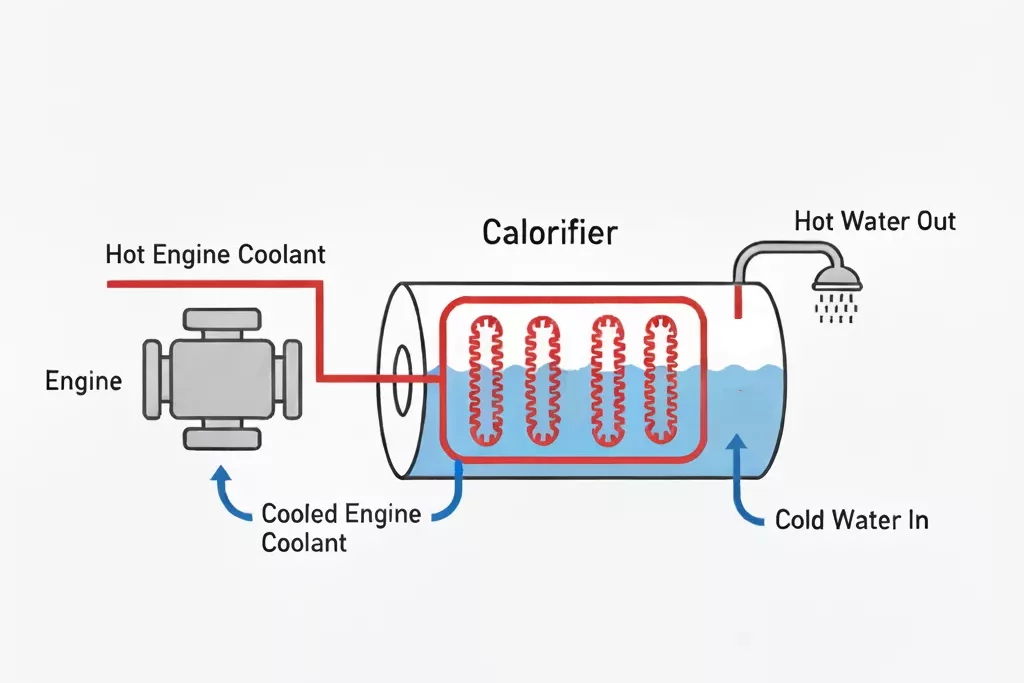
The real magic happens inside the tank. A coil, plumbed into your engine’s cooling system, acts as a heat exchanger. It captures warmth that would otherwise be lost straight overboard. As hot coolant from the engine circulates through this coil, it transfers that thermal energy to the fresh water held within the calorifier tank. This gives you a reliable and incredibly energy-efficient hot water supply, making life aboard that much more comfortable.
The Basic Principle of Heat Exchange
This infographic breaks down the simple journey of energy from your engine to your tap.
As you can see, the calorifier efficiently repurposes engine heat, turning a waste byproduct into a valuable onboard comfort. Getting your head around this core principle is the first step to unlocking consistent hot water whenever you’re out on the water.
This method of using recycled energy is really catching on. In the wider UK market, there is a clear move towards better energy efficiency in hot water systems.
Putting a calorifier water heater on your narrowboat, barge, or cruiser is easily one of the best comfort upgrades you can make. The most obvious win is its incredible energy efficiency. You’re literally getting free hot water by capturing engine heat that would otherwise just be wasted overboard.
This simple process dramatically cuts down your need for gas or diesel to heat water, which saves you both money and precious resources. That efficiency leads straight to the second major benefit: pure convenience. Just imagine finishing a day’s cruise and having a full tank of piping hot water ready for showers and washing up, all without any extra faff or cost.
Built for Life Afloat
Beyond just being clever and convenient, these systems are known for being seriously tough and reliable. A good quality calorifier water heater is designed from the ground up to handle the knocks and vibrations of the marine environment.
Built with simple, robust mechanics, units from trusted brands such as Surejust offer dependable performance season after season. They are a sound investment in both your comfort and your vessel’s self-sufficiency.
This durability means you’ll spend less time worrying about things breaking down and more time just enjoying being on the water. When you boil it down, the main advantages are clear:
Energy Savings: It uses “free” heat generated by your engine’s normal running.
On-Demand Comfort: Gives you a plentiful supply of hot water right after you’ve been cruising.
Proven Reliability: Made from tough materials like stainless steel for a long, trouble-free life.
For anyone looking to really get the most out of their heating setup, a calorifier can also be linked up with other systems, such as boat stoves and diesel heaters. You can find out more about combining different heat sources in our article on how back boilers for boats work. At the end of the day, fitting a calorifier is a straightforward, practical upgrade that makes your whole boating experience that much better.
How to Choose the Right Calorifier for Your Vessel
Picking the right calorifier water heater is all about making sure you have plenty of hot water without chewing up valuable space or energy. Getting this decision spot-on is a game-changer for a comfortable life aboard your narrowboat, cruiser, or barge.
What Size Do I Need?
The first, and probably biggest, decision is the tank size. It’s a real balancing act. Go too small, and you’ll run out of hot water halfway through a shower. Go too big, and you’re just heating water for the sake of it, wasting energy and taking up precious locker space.
Think about your typical crew size and your day-to-day hot water habits. A solo sailor might get by perfectly with a compact 15-litre unit. But if you’re a family living aboard, you’ll want to look at a 40-litre or even a 75-litre model to keep everyone happy.
To give you a rough idea, here’s a quick guide to help you estimate.
Quick Reference Calorifier Water Heater Size Guide
Tank Capacity (Litres)
Ideal for Crew Size
Typical Use Case
15-20
1 crew
Solo cruisers, weekend trips, minimal hot water needs (washing up, quick rinses).
25-40
2 crew
Couples living abroad, regular showering and daily use.
50-75
3+ crew
Families, liveaboards with higher demands (e.g., a bath), frequent guests.
This table should get you pointed in the right direction, but remember to consider your personal usage patterns when making the final call.
Material and Insulation Quality
Once you’ve got a size in mind, the next thing to look at is how the thing is built. The best calorifiers use top-notch materials for the inner tank to make sure they last and don’t corrode. Stainless steel is the premium choice here; it’s incredibly durable against both hard and soft water, promising a long, trouble-free life.
Insulation is just as crucial. A quality calorifier water heater should be wrapped in thick, high-density polyurethane foam. This is non-negotiable. It essentially turns your tank into a high-tech thermos, keeping heat loss to an absolute minimum. With good insulation, the water can stay hot enough for a shower for well over 24 hours after you’ve shut the engine down.
Single Coil or Twin Coil?
Finally, you need to decide on the coil setup. This dictates how you can heat your water.
Single-Coil Models: These are the standard workhorses. They connect directly to your engine’s cooling system and are simple, effective, and perfect for boaters who are regularly running their engine.
Twin-Coil Models: These give you much more flexibility by adding a second heat exchanger coil. This lets you hook up another heat source, like a diesel-fired cabin heater. It’s an ideal setup for liveaboards or winter cruisers who run their heating system a lot.
Just for perspective, UK government research shows that the average household gets through about 90 litres of hot water a day, which shows just how much demand can vary. Choosing the right calorifier ensures you have a reliable supply that’s properly tailored to your life on the water.
Making the right choice gives you peace of mind that your system is perfectly matched to your needs. You can see a range of high-quality options by exploring our selection of Surejust calorifiers and their specifications.
Key Installation and Safety Practices
Getting your calorifier installed safely and securely is absolutely crucial for its performance and, more importantly, your peace of mind out on the water. While this isn’t a step-by-step DIY guide, understanding the essentials is important, whether you’re tackling the job yourself or calling in a pro.
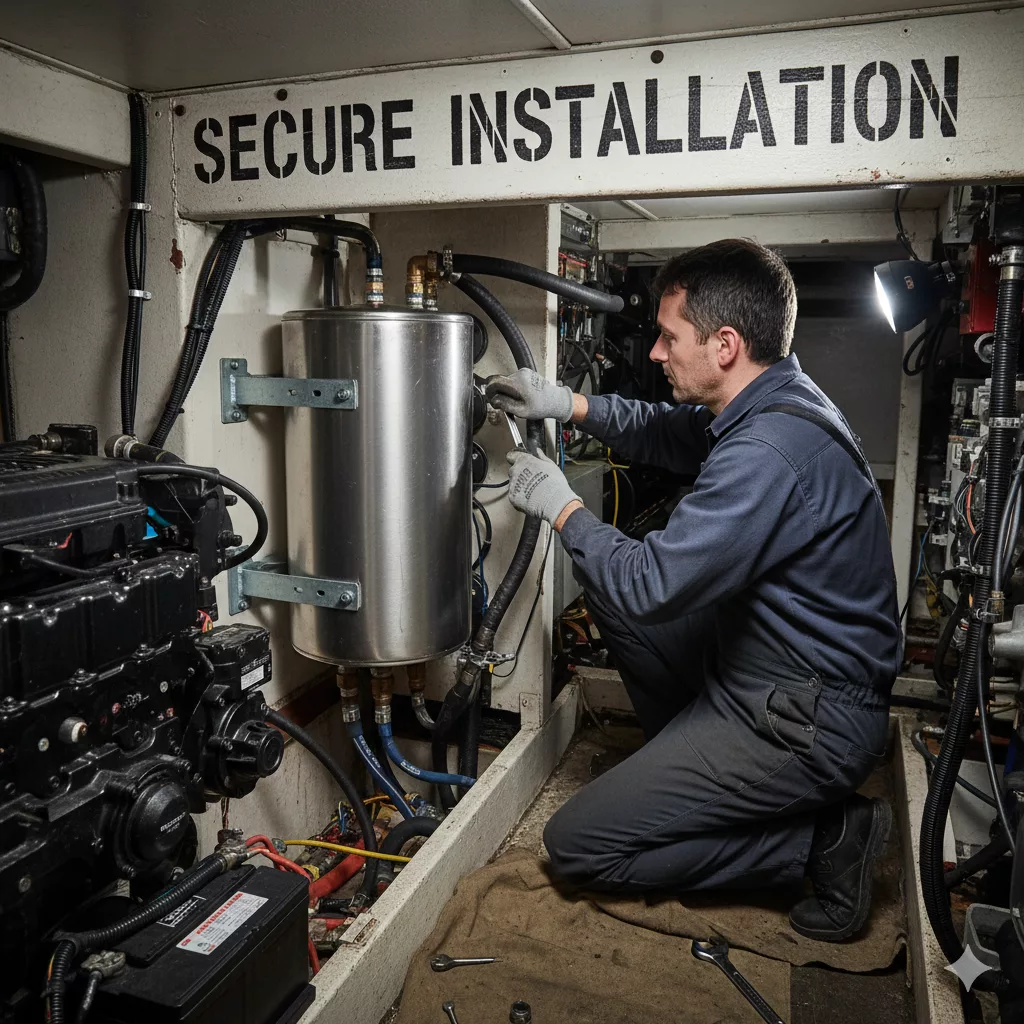
First things first, the tank has to be mounted solidly. On a boat, everything needs to be fastened down to handle the constant movement, vibration, and the occasional rough seas. This means your calorifier must be bolted firmly to a structural part of the boat, so there’s no chance of it shifting or breaking loose.
The plumbing connections are just as vital. It’s a careful job of tapping into both the engine’s coolant circuit and your boat’s freshwater system. You have to be sure every single connection is leak-proof and can withstand the pressures and temperatures involved.
The Most Important Safety Device
If there’s one component you can’t compromise on, it’s the Pressure Relief Valve (PRV). This small but mighty valve is your system’s number one safety feature.
It’s simple physics: as water gets hot, it expands. The PRV is designed to automatically open and vent that excess pressure if it ever builds up to a dangerous level, stopping the tank from rupturing. It is a non-negotiable part of any safe calorifier water heater setup.
Getting the PRV installation right comes down to a few key points:
Correct Rating: The valve’s pressure rating must match the specifications of your calorifier tank.
Proper Placement: It needs to be fitted directly onto the tank’s hot water outlet port. No exceptions.
Clear Discharge: The outlet pipe from the PRV must lead to a safe place, usually into the bilge, where hot water can be released without scalding anyone or damaging anything.
Given the complexities of engine plumbing and the critical safety elements at play, we always recommend getting a professional to handle the installation. Finding a qualified boat gas and heating engineer ensures the job is done to the highest safety standards, giving you total confidence in your new hot water system.
Simple Maintenance for Lasting Performance
Your calorifier is a bit of a low-maintenance workhorse, but a few simple checks will ensure it keeps delivering that lovely hot water efficiently for years to come. Think of it as a straightforward annual MOT to protect your investment and guarantee it won’t let you down when you need it most.
Kick things off with a good look at all the hose connections. You’re searching for any tell-tale signs of leaks, cracking, or general wear and tear. It’s also vital to manually test the pressure relief valve (PRV). Just lift its lever for a moment to confirm it opens and closes properly, which helps clear out any gunk that might be blocking it.
Annual Checks for Efficiency
If you’re moored up in a hard water area, limescale can be a proper pain. It’s a smart move to periodically check the immersion heater element for any scale buildup. A thick coating of scale can slash its efficiency and lead to it failing much sooner than it should.
A well-maintained calorifier is a reliable one. Committing just an hour each year to these simple checks prevents common failures and ensures your system is always ready for the season ahead.
To really get the most out of your calorifier and head off costly internal corrosion, it’s also worth understanding other key maintenance tasks. For instance, knowing about water heater anode rod replacement is incredibly valuable for prolonging the life of the tank.
Finally, winterising your system isn’t optional—it’s essential. Before that first frost hits, you must drain the calorifier completely. This stops ice from forming inside, which can easily crack the tank and cause catastrophic damage. It’s a simple step that saves a world of trouble.
Common Calorifier Questions Answered
Even when you’ve got your head around the basics of how a calorifier works, a few specific questions always seem to pop up. Getting straight answers is key to making the right choice and getting the best out of your boat’s hot water system.
So, let’s tackle the most common queries we hear from narrowboat and cruiser owners. This is the essential info, no fluff.
How Long Does Water Stay Hot in a Calorifier?
The simple answer is: remarkably long. A quality marine calorifier is packed with high-efficiency polyurethane foam insulation. Thanks to this, the water can stay hot enough for a decent shower for up to 24 hours after you’ve shut the engine down.
This fantastic heat retention means you can have a hot wash the morning after a cruise without having to fire up the engine or plug into shore power.
Do I Need a Calorifier with a Twin Coil?
A twin coil model is a brilliant option if you have a second way to generate heat on your boat. Think of a diesel-fired central heating system like a Webasto or an Autoterm. The second, independent coil lets your cabin heater warm up your domestic water, too.
It’s the perfect setup for liveaboards or winter cruisers. You might be running the heating frequently, but not necessarily the main engine every day. A twin coil gives you that extra flexibility.
What Happens if the Calorifier Gets Too Hot?
Every calorifier we install comes with a crucial safety feature: a Pressure Relief Valve (PRV). If the temperature or pressure inside the tank ever creeps above the safe limit, this valve automatically opens to release the excess.
This is a non-negotiable safety device that prevents the tank from rupturing. For extra protection against scalding at the tap, we also strongly recommend fitting a thermostatic mixer valve to blend hot and cold water to a safe, consistent temperature.
At Marine Heating Solutions, we supply and install a range of top-quality appliances, including the robust and reliable Surejust calorifier—perfect for the demands of life on the water. Find out more about our services at https://marinestaging.wp59.qa.internal.searchatlas.com/category/boat-services/, and get in touch for an estimate.
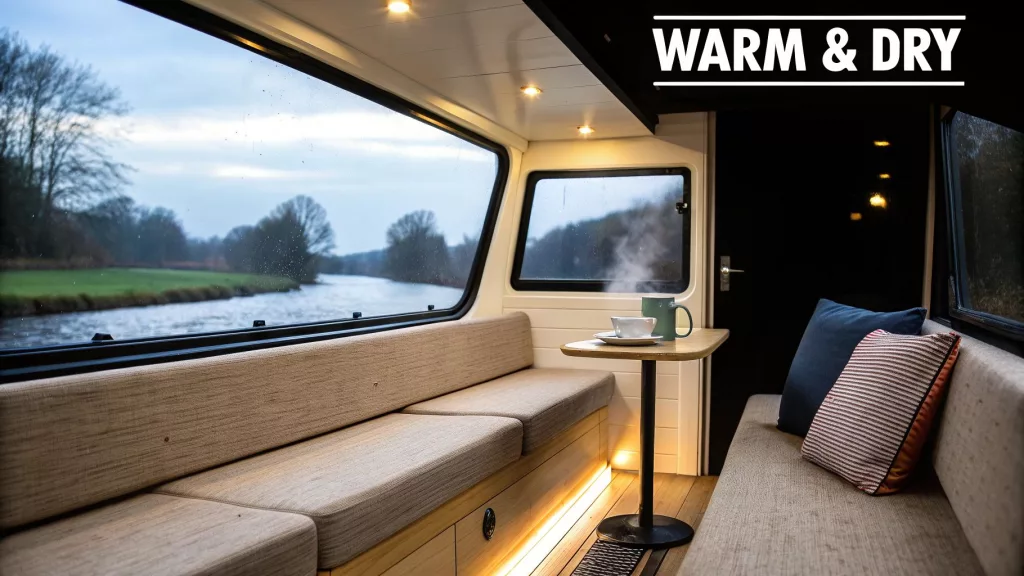
Staring out at a damp, chilly cabin can quickly suck the joy out of boating. Let’s be honest, a reliable diesel heater is what turns a boat from a fair-weather toy into a proper warm, dry sanctuary. It’s the single best upgrade for extending the UK boating season and making life afloat genuinely comfortable all year round.
Picture this: you’re casting off on a crisp autumn morning. The air outside is biting, but inside your cabin, it’s perfectly warm and inviting. That’s the reality a quality diesel heater gives you. It’s a world away from feeble electric heaters that chain you to shore power, or gas systems that can pump more moisture into an already damp environment.
Instead, boat heaters diesel systems offer robust, independent heating that runs off the same fuel you probably already have in your tank.
This self-sufficiency is a complete game-changer, especially for anyone who loves cruising the UK’s canals, rivers, and coastlines. Whether you’re away for a weekend or living aboard your narrowboat, you’re no longer tied to marina facilities just to stay warm. It’s the freedom to explore those quiet, remote anchorages and properly enjoy your boat through all four seasons, not just for a few fleeting summer months.
The Battle Against Damp and Condensation
One of the biggest headaches in any marine environment is moisture. It’s relentless. Water is everywhere, leading to condensation dripping down cold surfaces, which soon turns into musty smells, mildew, and a generally miserable atmosphere. This is where diesel heaters really shine, thanks to the dry heat they produce.
By actively pushing warm, dry air around the cabin, these systems do much more than just raise the temperature—they fundamentally change the environment. They slash humidity levels, stop condensation from forming on windows and bulkheads, and protect your boat’s interior from the slow, creeping damage caused by damp.
Reliable and Efficient Power
You’d be surprised at how little fuel modern boat heaters diesel systems actually use. They sip diesel at a rate as low as 0.1 to 0.2 litres per hour, giving you hours of consistent warmth from a tiny amount of fuel. This incredible efficiency makes them a genuinely cost-effective solution for keeping your boat comfortable long-term.
For anyone weighing up their options, the first step is to explore what a complete boat heating system looks like for your vessel.
Here in the UK, diesel heaters are the top choice for good reason. Their high heat output and sheer reliability are vital, especially on larger boats. These units work by combusting diesel to create blasts of warm, dry air—exactly what you need to fight back against the damp UK climate. The forced-air type is particularly popular, efficiently sending warmth through ducting to every corner of the boat, which dramatically cuts down on condensation and those lingering damp smells.
How Your Diesel Heater Creates Warmth
Ever wondered what’s actually going on inside that compact metal box keeping your cabin so toasty? Think of your diesel heater as a miniature, highly efficient furnace, but one that’s been cleverly engineered for the unique world of boating. It’s a smart bit of kit that safely turns a tiny amount of diesel into a powerful source of dry, comfortable heat.
The whole process kicks off the moment you turn it on. A small, precise fuel pump starts to tick, sipping a minuscule amount of diesel from your boat’s main tank or a dedicated day tank. This fuel then heads to the heater’s core, which is where the real magic happens.
The Combustion Process Step By Step
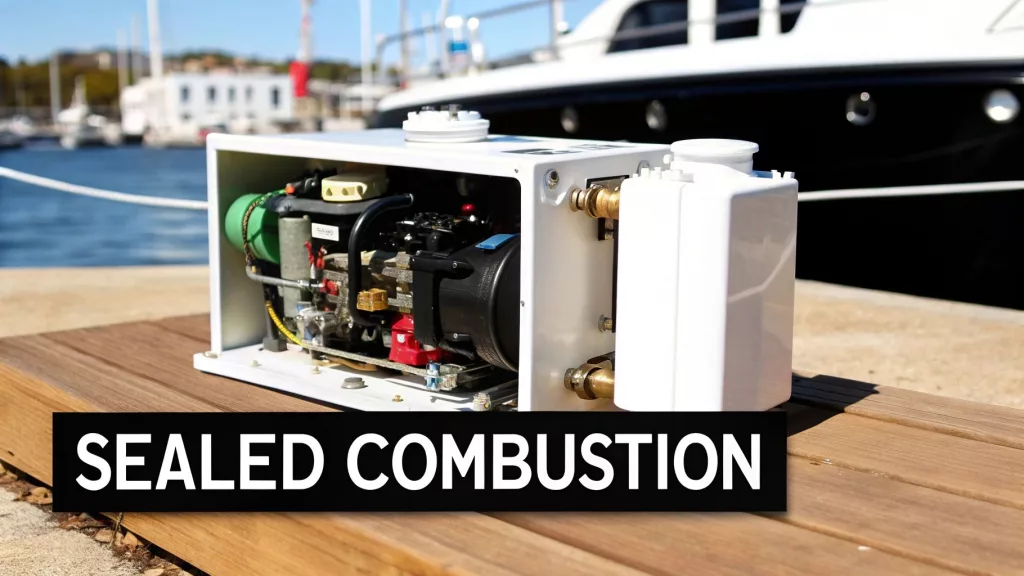
The heart of any diesel heater is its combustion chamber. Inside this completely sealed unit, a series of rapid events unfolds to create a controlled, clean-burning flame. It’s a process that has been fine-tuned over decades to be as efficient and safe as possible.
Glow Pin Ignition: First, an electrical part called a glow pin heats up until it’s literally red hot, a bit like the element in an old car cigarette lighter. This provides the initial spark needed to get things started.
Fuel Atomisation: At the same time, the diesel fuel is sprayed over a fine mesh screen. This turns the liquid into a fine vapour, or ‘atomises’ it, making it much easier to ignite.
Controlled Combustion: A small combustion fan pulls in fresh air from outside the boat and forces it into the sealed chamber. This air mixes with the diesel vapour, and the glowing pin ignites the mixture, creating a small but stable flame.
Once the flame is properly established and an internal sensor gives the all-clear, the glow pin switches itself off. The heater then carries on running, tweaking the fuel pump and fan speed to keep your cabin at the exact temperature you’ve set.
The Critical Safety Separation
This entire combustion process happens within a completely sealed system. This is, without a doubt, the single most important design feature of any quality marine diesel heater. It’s what makes them fundamentally safe to run in an enclosed space like a boat cabin.
The air used for burning the fuel is drawn from outside your boat, and the exhaust fumes are immediately vented back outside through a dedicated, sealed exhaust pipe. At no point do these combustion gases ever mix with the air you breathe inside the cabin.
This total separation is your guarantee that dangerous fumes like carbon monoxide stay safely outside. It’s exactly why a professionally installed system from a reputable brand is non-negotiable for life on the water and a world away from other heating methods that can pump moisture or harmful by-products into your living space.
Transferring Heat into Your Cabin
So, with the flame burning safely inside a sealed box, how does all that lovely heat actually get into your cabin? This is the job of a component called a heat exchanger.
Imagine the combustion chamber is like a very hot pipe. The heat exchanger is basically a larger casing built around this pipe, often covered in fins to increase its surface area. A second, much larger fan then draws cool air from inside your cabin and blows it over the hot outer surfaces of this heat exchanger.
As the cabin air tumbles over these hot metal fins, it soaks up the thermal energy and becomes warm. This newly heated air is then pushed out through ducting into your cabin, raising the temperature surprisingly quickly.
The principle is similar in a hydronic (or ‘wet’) system, but instead of air, a water-glycol mix is pumped through a “water jacket” around the heat exchanger. This heated liquid then circulates through radiators to warm the boat. We sell a range of reliable air and water heaters, including popular models like the Autoterm 4D Diesel Air Heater and the powerful Webasto Thermo Top Evo, which are perfect examples of this safe and efficient technology in action.
Forced Air vs Hydronic Heaters: Deciding What’s Right for You
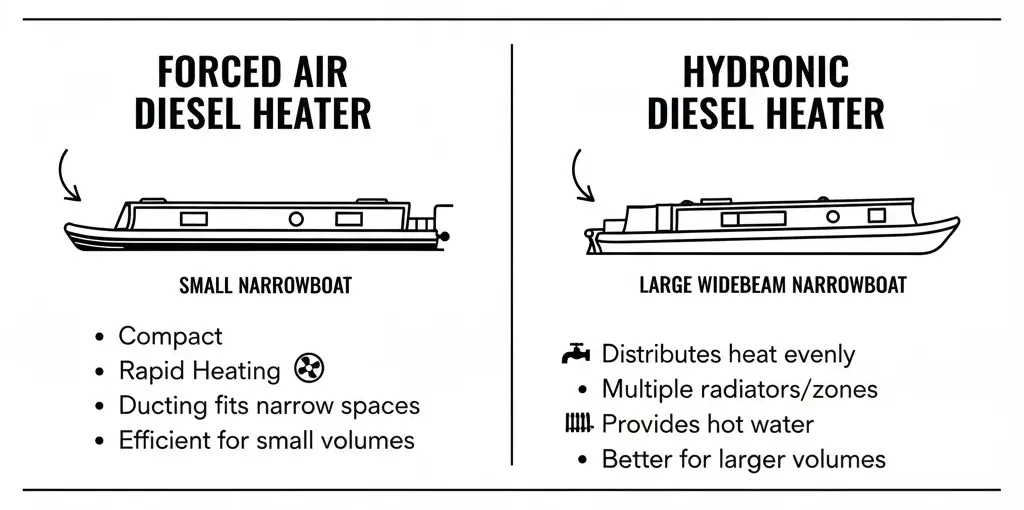
Choosing between a forced air and a hydronic system is the biggest decision you’ll make when fitting out your boat with diesel heating. This choice directly shapes your daily comfort on the water. It’s not really about which is ‘better’ overall, but which is fundamentally right for your specific vessel and how you plan to use it.
Each system works brilliantly, but they deliver warmth in completely different ways. One is like a powerful, quick-acting fan heater, delivering instant results. The other is like having traditional central heating from home, providing a silent, gentle warmth that permeates the entire boat. Let’s break down the comparison.
Forced Air Heaters: Quick, Dry and Simple
Forced air systems are the sprinters of the marine heating world. Their main job is to heat air directly and circulate it fast. A powerful fan draws in cool cabin air, passes it over a hot heat exchanger, and immediately pushes the warmed air out through ducting to various outlets around your boat.
This direct approach has some pretty big advantages. The most obvious is the speed of heating. A forced air unit can take the chill off a cold, damp cabin in a matter of minutes, making it absolutely perfect for weekend cruisers or day boats. If you arrive at your boat on a Friday evening, you can have the space warm and welcoming before you’ve even unpacked your bags.
What’s more, because these systems move a large volume of air, they are incredibly effective at combating condensation. The constant circulation of warm, dry air is the enemy of damp, helping to keep windows clear and preventing that musty feeling that can plague boats, especially GRP cruisers. You can explore a great selection of reliable and popular systems by checking out our range of diesel air heaters.
Best Suited For:
Weekend and Holiday Cruising: Ideal for quickly heating a cold boat for shorter trips.
Smaller Vessels (under 40ft): Simple ducting runs make for a straightforward and effective installation.
GRP (Fibreglass) Boats: Excellent for tackling the condensation issues common in these hulls.
Simpler Installations: Fewer components and less complex plumbing mean a faster and often more affordable setup.
Hydronic Heaters: Silent, Even and Versatile
If forced air heaters are the sprinters, hydronic systems are the marathon runners. They provide a slower, gentler, and more pervasive heat that feels just like a well-insulated home. Instead of heating air, a hydronic heater warms a liquid—typically a water and antifreeze mixture.
This heated fluid is then silently pumped through a circuit of pipes to radiators or fin rads strategically placed throughout the boat. The radiators then release their warmth into the cabin through natural convection. The result is a completely silent, even heat with no cold spots and no fan noise.
The real trump card of a hydronic system, however, is its ability to produce domestic hot water. By integrating a calorifier (hot water tank) into the heating circuit, the system can heat your water for hot showers and washing up. This single feature makes it the undisputed champion for liveaboards.
Best Suited For:
Liveaboards and Long-Term Cruisers: The silent, consistent heat and domestic hot water are essential for everyday comfort.
Larger Vessels (over 40ft): It’s far easier to run small water pipes than large air ducts to distant cabins.
Steel Narrowboats and Barges: The gentle, radiant heat is perfect for warming the steel hull and creating a cosy environment.
Ultimate Comfort: For those seeking a truly home-like atmosphere on the water, nothing beats hydronic heating.
A Head-to-Head Comparison
To make the decision a bit clearer, it helps to put the two systems side-by-side and see how they stack up on the features that matter most.
Comparing Forced Air and Hydronic Diesel Heaters
Feature
Forced Air Heaters
Hydronic (Water) Heaters
Heating Speed
Very fast; provides almost instant heat.
Slower to warm up the boat initially.
Noise Level
Audible fan noise when running.
Virtually silent operation.
Heat Quality
Direct, circulated warm air.
Gentle, radiant heat from radiators.
Condensation
Excellent at reducing damp and condensation.
Good, but less aggressive than forced air.
Hot Water
No; purely for space heating.
Yes; can be plumbed to a calorifier.
Installation
Simpler; requires large-diameter air ducting.
More complex; involves plumbing, radiators, and pumps.
Power Draw
Moderate; mainly for the fan and glow pin.
Lower once running, but higher initial draw.
Ideal Boat
GRP cruisers, smaller boats, weekenders.
Steel narrowboats, Dutch barges, liveaboards.
Ultimately, your choice hinges on your lifestyle. If your priority is blasting a cold boat with heat for a weekend trip, a forced air system is your best friend. But if you call your boat home and value silent, all-encompassing warmth and the luxury of hot running water, then a hydronic system is the clear winner.
Choosing the Perfect Heater Size for Your Vessel
Picking the right heater isn’t just a case of grabbing the most powerful one off the shelf. It’s about striking a careful balance between efficiency, comfort, and the lifespan of your system. Think of it like this: you wouldn’t fit a massive outboard engine on a tiny tender. The same logic applies here. Getting the size just right is key to creating a warm, dependable sanctuary on the water.
This decision tree gives you a quick visual guide on what type of heater generally suits different boat sizes.
As you can see, smaller boats often do well with the quick, direct blast of warmth from a forced-air heater. On the other hand, larger vessels get more out of the quiet, even heat from a hydronic system.
Why Bigger Isn’t Better
It’s a common mistake to think that buying an oversized heater will just warm the boat up faster. In reality, a unit that’s too powerful for the space will cause you more grief than it solves. It will fire up, blast the cabin to the target temperature in no time, and then shut down. A few minutes later, the temperature drops, and the whole cycle kicks off again.
This constant on-off process is known as short cycling, and it’s horribly inefficient. Not only does it guzzle more fuel, but it also puts unnecessary strain on components like the glow pin and fuel pump. Worst of all, it leads to a rapid build-up of carbon and soot inside the combustion chamber. Eventually, this will choke the heater, causing poor performance and premature failure.
The Problem with Undersized Heaters
Going too small is just as bad. A heater that’s not up to the job will run flat out, constantly struggling to reach a temperature it can never maintain. Your cabin will never feel properly warm and comfortable, and the heater will be pushed to its absolute limit for long stretches.
This continuous high-load operation wears out components much quicker and burns through fuel without ever delivering the cosy warmth you’re after. The sweet spot is a unit that can happily maintain your ideal temperature by ticking over on a low or medium setting for long, steady periods.
How to Calculate Your Heating Needs
Figuring out the exact heating output your boat requires means looking at several key factors. While a professional installer can give you a precise recommendation, you can get a pretty good idea by considering these elements:
Boat Length and Volume: It’s simple, really. A longer, wider boat with high ceilings has a much larger volume of air to heat than a compact cruiser.
Insulation: How well-insulated is your boat? A steel narrowboat with spray foam insulation will hold its heat far better than a single-skinned GRP cruiser. Poor insulation means you’ll need more grunt to make up for heat loss.
Layout: An open-plan saloon is much easier to heat than a layout with multiple small, enclosed cabins, which can trap cold spots.
Intended Use: Are you planning to be on the water in the depths of a UK winter, or just on cool autumn evenings? Your heating demands will naturally change with the seasons.
As a general rule of thumb for a reasonably insulated vessel, a 2kW heater is often sufficient for boats up to around 30 feet. For boats between 30 and 40 feet, a 4-5kW unit is usually a better choice. For anything larger, or for those wanting a hydronic system, a more detailed calculation is essential.
The demand for reliable marine heating is huge. The global marine heating market was valued at approximately USD 1.2 billion in 2023, with projections showing strong growth. The UK market is a major driver in Europe, where strict regulations and a large fleet create high demand for quality heating. Diesel systems are a dominant choice here, thanks to their proven reliability. You can discover more insights about the marine heaters market and its growth.
Critical Safety Rules for Heater Installation
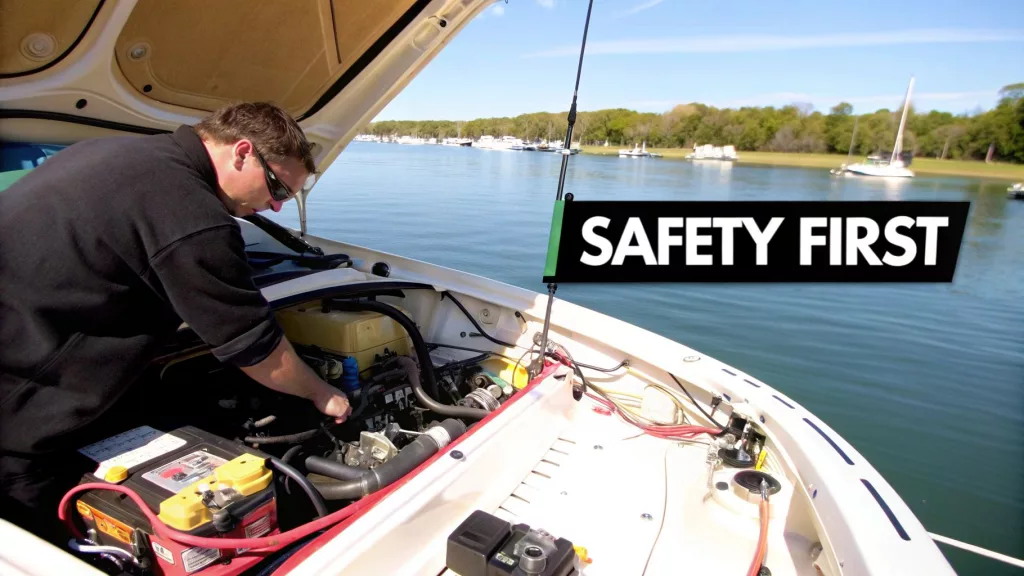
When it comes to putting any fuel-burning appliance on your boat, safety is the one area where you simply cannot cut corners. It’s a non-negotiable.
While getting a certified technician to do the job is always the smartest move, every boat owner needs to grasp the core safety principles. These aren’t just friendly suggestions; they’re absolute must-dos to protect your vessel and everyone on it.
A quality heater from a reputable brand, fitted correctly, is a wonderfully safe and reliable bit of kit. Get the installation wrong, however, and you’re opening the door to serious risks, from fire to lethal gases. Sticking to established marine standards is everything.
Isolate the Combustion Circuit
This is the golden rule for installing boat heaters diesel fuel systems: the air the heater uses to burn fuel and the resulting exhaust fumes must be completely separate from the air you breathe in the cabin.
Combustion Air Intake: This pipe needs to pull fresh air from outside the living space, like a cockpit locker or straight through the hull. It must be well clear of any engine fumes or other contaminants.
Exhaust Outlet: The exhaust gases have to be vented safely overboard through a purpose-built, gas-tight marine skin fitting.
Crucial Separation: The intake and exhaust outlets must be positioned a good distance from each other. If they’re too close, the heater can suck its own exhaust back in. This leads to poor combustion and, critically, the creation of deadly carbon monoxide.
Manage the Heat Safely
That exhaust pipe gets seriously hot. We’re talking hot enough to set fire to nearby flammable materials if you’re not careful. Managing this heat is a vital part of fire prevention.
The most important step is to lag the exhaust pipe with high-temperature insulation wrap for its entire length inside the boat. This dramatically reduces the surface temperature, protecting woodwork, wiring, and other materials from coming into contact with a dangerously hot surface.
You also need to give the heater unit itself some breathing room. Make sure there’s plenty of clearance for air to circulate and stop it from overheating. Never box it into a tight, unventilated cupboard or stuff things up against its casing.
Comply with the Boat Safety Scheme
Here in the UK, the Boat Safety Scheme (BSS) lays down the minimum safety standards for boats on most inland waterways. While it’s a legal requirement for your licence, following BSS guidelines is just good sense for any boater, anywhere.
A key point an examiner will check is that any fuel-burning appliance is fitted according to the manufacturer’s instructions and the relevant safety standards. This covers everything from using proper marine-grade parts and secure fuel lines to ensuring the exhaust system is correctly sealed and installed.
The Silent Killer Carbon Monoxide
Carbon monoxide (CO) is the big one. It’s an odourless, colourless gas produced when fuel doesn’t burn completely. It is incredibly poisonous and can be fatal in minutes.
Even a perfectly installed diesel heater can produce CO if it malfunctions or is starved of air.
That’s why a working carbon monoxide alarm isn’t an optional extra; it’s a critical piece of life-saving equipment. Install it in the same cabin as the heater, ideally at head height. You can find out more crucial information by reading our guide on how to prevent carbon monoxide poisoning. Treat it just like a smoke alarm: test it often, change the batteries, and replace the whole unit when the manufacturer says so.
Keeping Your Heater Running Smoothly
Your diesel heater is a seriously hardworking bit of kit. Just like your main engine, a little TLC goes an incredibly long way. Putting a simple maintenance schedule in place is the single best thing you can do to make sure it fires up reliably every time, heading off most common problems before they leave you shivering.
A few straightforward checks will keep your system running like a dream for years to come. It’s not just about staying warm; this proactive approach protects your investment and ensures your boat remains a comfortable haven, whatever the weather throws at you.
Simple Monthly Checks
Believe it or not, the most common reason a boat heater diesel system fails to start is carbon buildup. This is a classic problem that crops up when a heater is only ever run on a low setting for short bursts. It never gets properly hot, so it can’t burn itself clean. Luckily, the fix is dead simple.
Once a month, get into the habit of running your heater flat out on its highest setting for at least 30 minutes. Think of it as an “Italian tune-up.” This gets the combustion chamber scorching hot, burning off all the sooty gunk that clogs up the glow pin and fuel screen. A clean start, every time.
While you’re at it, a quick visual once-over each month can nip potential issues in the bud. Have a look at your fuel lines for any signs of cracking or weeping, and make sure all your electrical connections are tight and free of any green, fuzzy corrosion.
Annual Servicing Tasks
Once a year, usually just before the cold weather sets in, your heater deserves a more thorough service. This is absolutely key to its long-term health and performance, just like the annual service for your boat’s engine. Skipping this can lead to a slow decline in performance and could even compromise the unit’s safety.
A full annual service really boils down to a few essential jobs:
Decoking the Burner: This involves carefully opening up the combustion chamber and physically cleaning out all the accumulated carbon and soot.
Replacing the Glow Screen: This is a fine mesh gauze that turns the diesel into a fine mist for ignition. It’s a consumable part that gets clogged over time and is best replaced annually.
Checking the Glow Pin: While you’ve got the heater apart, it’s a good idea to inspect the glow pin for wear and test its resistance to make sure it’s heating up properly.
This focus on proper maintenance is something we see across the UK marine sector. The market for marine diesel engines and their add-ons, including heaters, is set to grow, all driven by a demand for efficiency and reliability. For us boat owners, that just highlights how important it is to look after high-quality equipment.
If you’d rather leave the servicing to the professionals, our team is here to help. You can find out more about what’s involved by reading our guide on servicing diesel-burning appliances on boats.
Common Questions About Diesel Boat Heaters
After getting your head around how these heaters work, it’s totally normal to have some practical questions about fitting one and living with it day-to-day. We hear many of the same queries from boat owners time and again, so let’s tackle the most common ones to help you feel confident about your choice.
These are the real-world details that actually matter, from running costs to how much noise they make. Getting straight answers is key to making sure you enjoy every moment on the water.
How Much Fuel Do They Use?
This is usually the first question on everyone’s lips, and the answer is often a pleasant surprise. Fuel consumption on a boat heaters diesel system is remarkably low. A typical 2kW heater, like the ever-popular Autoterm 2D Diesel Air Heater, will only sip about 0.15 to 0.20 litres of diesel per hour when it’s ticking over on a medium setting.
Even if you step up to a more powerful 4-5kW unit, you’re only looking at around 0.25 to 0.50 litres per hour on high. This incredible efficiency is exactly why they’re the go-to choice for liveaboards and anyone cruising off-grid for long stretches.
Are Diesel Heaters Noisy?
Modern, good-quality diesel heaters are designed to be pretty quiet. Inside the cabin, the main sound you’ll notice is the gentle whisper of the fan pushing warm air around, much like a central heating system at home.
The only other noise comes from outside the boat. The small fuel pump makes a distinct ticking sound as it works. This is easily sorted by mounting the pump on a flexible rubber bracket, which dampens the vibration and makes it barely noticeable.
Can I Run My Heater While Underway?
Absolutely. Any reputable marine diesel heater is built specifically to be used safely while your boat is on the move. Whether you’re chugging along a canal or sailing in choppy seas, the system will carry on working just fine.
Firing up the heater during a chilly passage is a brilliant way to keep the cabin warm and, just as importantly, dry. It means that when you finally moor up, you step into a comfortable, welcoming space, ready to put your feet up rather than facing the grim task of blasting a cold, damp cabin with heat.
Our Services For Boat Heaters Diesel Systems
For expert advice on choosing and installing the perfect diesel heating solution for your boat, you can trust the certified engineers at Marine Heating Solutions. Take a look at our range of high-quality heaters and services at https://marinestaging.wp59.qa.internal.searchatlas.com/boat-appliances, and get in touch for an estimate!
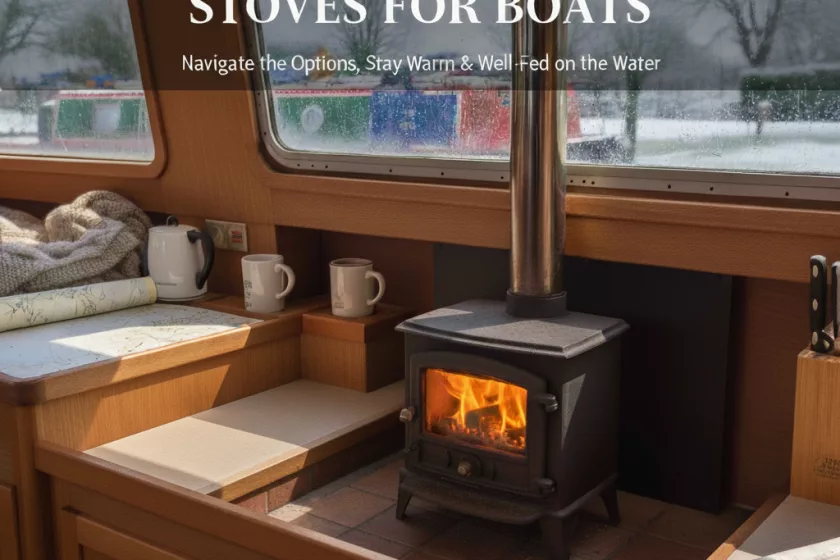
Picking the right appliance from our stoves for boats is one of the biggest decisions you’ll make. It’s not just about heating; it’s the heart of the vessel, providing warmth, comfort, and a dry haven out on the water. A good choice makes life aboard a dream, while a bad one can become a source of endless headaches and safety worries.
Selecting the proper stove for your boat, specifically a solid fuel or diesel stove, is crucial for both comfort and safety. A good stove acts as a reliable source of warmth, helping to create a cosy atmosphere. However, choosing the right one can be a daunting task with various options available, tailored to different boat styles and needs.
Understanding Your Needs and Priorities
Before you jump into the options available, consider a few key points to help guide your decision-making process:
Heating Requirements: Are you looking primarily for a heating solution or a multi-functional appliance? Solid fuel and diesel stoves are adept at providing consistent warmth.
Fuel Accessibility: Assess how easily you can source your chosen fuel type. Diesel stoves may access fuel from your main engine tank, while solid fuel solutions need continuous management of wood or coal.
Boat Configuration: The layout and size of your boat will determine what stoves are practical. Compact designs cater better to smaller vessels, while larger options with back boilers might be more appropriate for spacious interiors.
Boating Lifestyle: Continuous cruisers may prioritise durability and high efficiency in their stove choices, whereas those who use their boats occasionally might opt for simple, user-friendly solutions.
A Look at UK Boater Preferences
In the UK, usage patterns for marine stoves vary widely. Most boaters prefer diesel stoves for boats because of their reliability and efficiency. According to surveys, solid fuel stoves evoke a sense of nostalgia and traditional boat life that resonates well with many seasoned sailors.
Remember that selecting a stove is more than just a check-list item; it’s about enhancing your boating experience.
Understanding Boat Stove Fuel Options
Choosing the fuel type can significantly impact your day-to-day experience aboard. Diesel and solid fuel options come with distinct advantages and some challenges. It’s wise to properly assess what best suits your lifestyle.
Diesel Stoves for Boats: Reliable Heat
Diesel stoves are increasingly favored by serious boaters and narrowboat dwellers for their dependability and ability to create dry heat that prevents humidity buildup.
The benefits of diesel stoves include:
Convenient Fuel Supply: Diesel stoves connect directly to your boat’s main fuel tank, minimising the hassle of additional fuel storage.
High Efficiency: They produce powerful, long-lasting heat, making them ideal for colder conditions.
Fewer Emissions: Diesel stoves produce fewer emissions and pollutants compared to solid fuel stoves, making them a more environmentally friendly option and ideal for smoke-controlled zones.
Cleanliness and Efficiency: Diesel stoves create no ash and less dust in the cabin, and there’s no need to carry and store bulky solid fuels. Additionally, they are often more fuel-efficient and can reduce heating costs over time.
It’s important to clarify that these stoves do not require electrical systems to operate; they are gravity-fed and extremely reliable.
Solid Fuel Stoves for Boats: The Traditional Choice
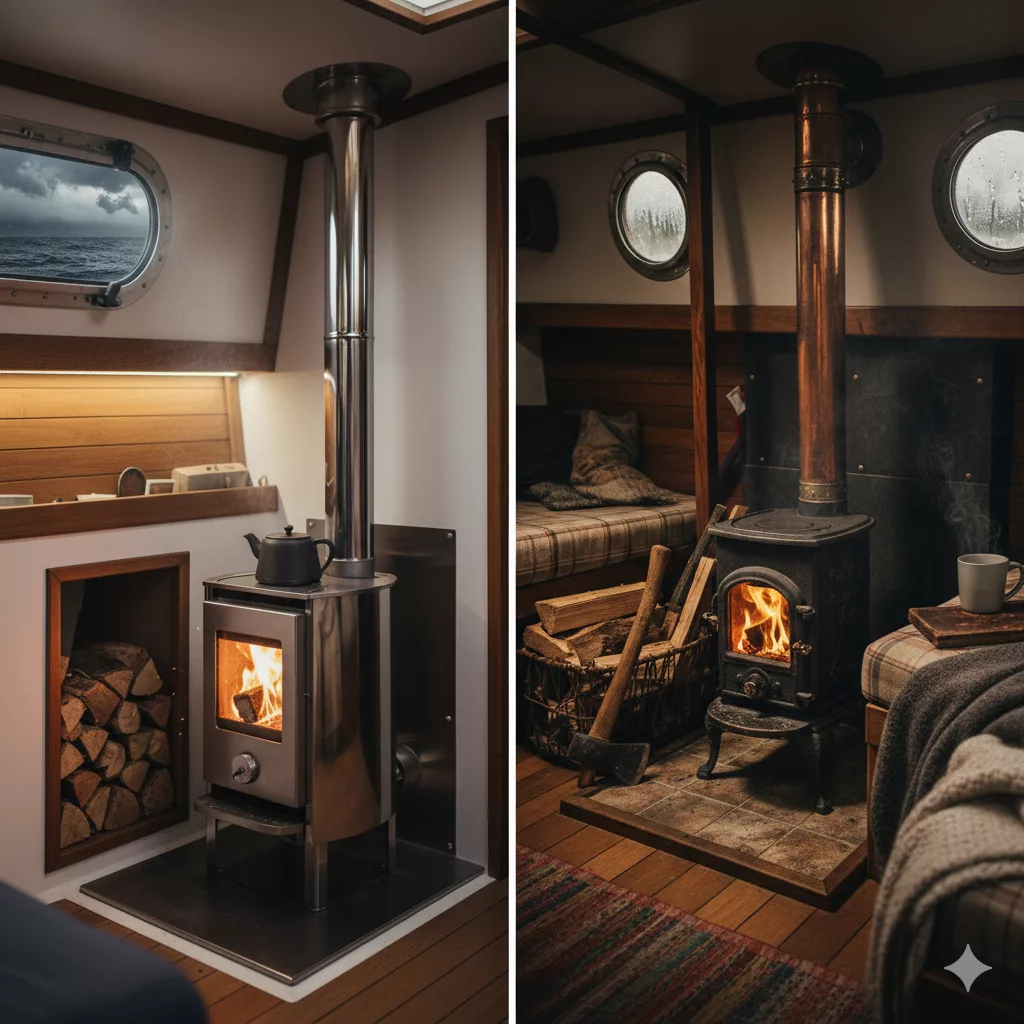
Solid fuel stoves create that inviting, hearth-style atmosphere, serving as a focal point while generating significant heat. They are preferred by boaters who appreciate the charm of a real fire.
Key features include:
Strong, Radiant Heat: They produce substantial amounts of dry heat, essential for warming cabins and avoiding dampness.
Off-the-Grid Capability: Solid fuel stoves don’t require an electrical supply, offering true independence at sea.
Although solid fuel models demand more attention for fuel sourcing, cleaning, and maintenance, they offer an unmatched warmth that many boaters cherish.
Safety and Installation Considerations
Ensuring proper installation is vital for the safe operation of any stove. Poor fitting can lead to serious hazards, such as fires or carbon monoxide emissions. Compliance with the Boat Safety Scheme (BSS) is not just recommended but essential. For a wider view on keeping your vessel safe, an ultimate boat safety checklist is a great resource that covers much more than just stoves.
Preparing Your Hearth
A solid, non-combustible hearth is critical for both solid fuel and diesel stoves, providing protection against intense heat and fire hazards. Hearths should be constructed from fire-resistant materials extending sufficiently around the stove.
Managing Flues and Heat
The flue system is crucial for venting smoke and gases outside your boat. It should be kept well away from any flammable materials. Consider factors like the flue’s height and ensuring proper insulation throughout the installation.
Safety Protocols for Diesel and Solid Fuel Stoves for Boats
Installations of stoves for boats must meet rigorous safety standards:
Non-Combustible Hearth: A hearth is required to extend 150mm on the sides and rear, and 225mm at the front.
Flue Requirements: Using insulated twin-wall flue systems is essential for both stove types.
Ventilation Needs: Adequate ventilation is required to ensure proper combustion. This is a regulatory requirement that must be adhered to for safety.
Ensuring your installation meets necessary guidelines is best performed by qualified professionals. Your can read more about boat stove safety in our blog post entitled “Is Your Boat Stove Safe To Use?”.
Safety Checklist for Boat Stove Installation
Here are just a few of the points that our engineers have on their checklist. All fuel-burning appliances should be installed and serviced on an annual basis by a qualified boat heating engineer.
Safety Check
Diesel Stove
Solid Fuel Stove
Non-Combustible Hearth
Required
Required
Heat Shielding
Necessary
Required
Secure Mounting
Must be bolted down
Must be bolted down
Flue Type
Recommended: Insulated twin-wall
Required: Insulated twin-wall
Fuel Line Safety
Fire-rated hoses, shut-off valve
Not applicable
Ventilation
Required
Required (550mm² per 1kW)
CO & Smoke Alarms
Required
Required
Professional Sign-Off
Recommend OFTEC technician
Recommend Oftec or Hetas installer
For a more detailed walkthrough on specific parts and procedures, our complete guide on stove care and repair provides practical, step-by-step advice.
Maintaining Your Marine Stove
Regular maintenance ensures optimal operation and safety. Consider a seasonal routine to keep your stove in top condition.
For Solid Fuel Stoves
With solid fuel stoves, managing the flue is a priority. Monthly sweeping of the flue is crucial, along with checking seals and bricks for wear.
For Diesel Stoves
Routine cleaning is essential to maintain airflow and fuel efficiency. Regular inspection of the burner pot and metering valve will enhance performance, too.
Our Top Picks for Boat Stoves
Having discussed the essential features, let’s dive into some reliable stove options. The right selection enhances your overall boating experience.
For Dedicated Narrowboat Liveaboards
For individuals who dedicate a significant amount of their time aboard their boats, the decision to invest in a high-quality diesel stove specifically engineered for both durability and optimal performance becomes crucial for ensuring a comfortable and reliable experience. Choosing a stove from reputable brands such as Bubble, Refleks, Dickinson, and Morso not only enhances the overall ambience of the vessel but also guarantees consistent heating, making those chilly evenings much more enjoyable. With such appliances, boaters can enjoy the luxury of home-cooked meals while navigating the open waters, thus transforming their boating experience into one of warmth and comfort, no matter the weather conditions they face.
For Casual Canal Cruisers and Families
Solid fuel stoves for boats are an excellent choice for enhancing the charm and comfort of weekend getaways, providing both a cosy ambience and effective heating capabilities. These stoves not only serve as a practical heating source but also contribute to the rustic aesthetic of cabins or lodges, creating a warm and inviting atmosphere that encourages relaxation. Whether nestled in a picturesque mountain retreat or a serene lakeside escape, the crackling flames and comforting heat of a solid fuel stove can transform an ordinary getaway into an extraordinary experience, making it the perfect centrepiece for gatherings with family and friends.
For Traditionalists Seeking Comfort
A classic solid fuel stove not only serves as a functional heating element but also acts as a captivating and inviting centrepiece, drawing guests in with its warm, flickering flames that create a cosy, homey atmosphere on board. Its rustic charm and nostalgic essence provide a sense of comfort and serenity, making it the perfect addition for anyone seeking to enhance their living space with a touch of traditional elegance and the soothing ambience that only a real fire can deliver.
Frequently Asked Questions About Boat Stoves
Do I Need a Carbon Monoxide Alarm?
Having a certified carbon monoxide (CO) alarm is not only essential for ensuring the safety of all occupants on board but also serves as a mandatory requirement under the Boat Safety Scheme (BSS). These alarms play a critical role in detecting the presence of this colorless and odourless gas, which can accumulate in enclosed spaces and pose serious health risks. By installing a reliable carbon monoxide alarm, boat owners take a proactive step toward safeguarding their well-being and that of their guests, making it a crucial component of boat safety regulations.
Can I Install a Stove Myself?
While a number of enthusiastic individuals might choose to take on the task of installing stoves by themselves, it is essential to emphasise the importance of adhering to safety regulations throughout the process. These regulations are not merely suggestions but crucial guidelines designed to prevent accidents and ensure the proper functioning of the appliances. Given the potential hazards associated with improper installation, particularly when dealing with gas-powered appliances, it is strongly recommended to seek professional installation services. By hiring a qualified technician, homeowners can gain peace of mind knowing that the installation is conducted safely and in compliance with all local codes, ultimately enhancing both safety and efficiency in their kitchen environment.
What Is Meant by ‘Dry Heat’?
The phenomenon known as ‘dry heat,’ which is generated by solid fuel and diesel stoves, plays a crucial role in controlling indoor humidity levels. This type of heat effectively reduces moisture in the air, creating an unfavourable environment for mould and mildew to thrive. By lowering humidity levels, dry heat not only helps to protect the structural integrity of buildings but also contributes to the well-being of the inhabitants by minimising the risk of respiratory issues associated with mould exposure.
Furthermore, implementing dry heat helps to ensure that surfaces remain dry, thereby preventing potential damage to furniture and other household items that can be harmed by excess moisture. In summary, utilising dry heat from solid fuel and diesel stoves is essential for maintaining a healthy home environment, especially in areas where humidity levels can rise significantly.
Our Services:
For the best solutions tailored to your needs, Marine Heating Solutions specialises in stove installations for boats, guaranteeing compliance with all safety standards. Explore our comprehensive range of heating solutions at https://marinestaging.wp59.qa.internal.searchatlas.com/boat-appliances/.
Getting a qualified boat gas engineer on board isn’t just a good idea—it’s absolutely essential for any vessel with an LPG system. A boat is a world away from a house. It’s a unique environment where constant vibration, humidity, and movement demand a very specific set of skills. Only a professional with the right marine qualifications can guarantee your systems are safe, compliant, and won’t let you down.
Why Specialist Expertise is Non-Negotiable on the Water
Imagine you know how to drive a car perfectly. Now, picture someone handing you the keys to an articulated lorry and telling you to navigate a tight, winding country lane. The basics of driving are the same, but the specific skills, awareness of new dangers, and the rules you have to follow are completely different. That’s the difference between a domestic gas fitter and a specialist boat gas engineer.
A boat’s gas system faces challenges you’d never encounter in a home. The constant motion can stress fittings over time, the damp, salty air can eat away at pipework, and getting ventilation right in a confined hull is a complex art. Someone without the right training might install a system that looks like it’s working, but they could be creating a silent, ticking time bomb.
The Hidden Dangers of a Bad Gas Job
The risks that come with a poorly installed or neglected gas system on a boat are terrifyingly real. It’s not just about an appliance failing to light; the consequences can be catastrophic.
Fire and Explosion: LPG is heavier than air. If there’s a leak, the gas won’t just float away. It will sink and pool in the bilge or other low spots in the hull, creating an invisible, highly explosive hazard just waiting for a single spark.
Carbon Monoxide Poisoning: Incorrectly fitted flues or poor ventilation can cause this deadly, odourless gas to build up inside your cabin. You can learn more about how to prevent carbon monoxide poisoning and spot the symptoms in our detailed guide.
A boat is not a floating house. It’s a dynamic, moving environment where safety standards have to be followed to the letter. Bringing an unqualified person in for gas work puts you, your family, and every boat moored nearby at unacceptable risk.
The demand for properly qualified engineers is a crucial part of the UK’s wider marine engineering sector, which is a major player in the national economy. As regulations get stricter, the need for certified specialists who genuinely understand these complex onboard systems is only going to grow. When it comes to gas on the water, choosing a certified professional is the only way to get true peace of mind.
Decoding Engineer Qualifications and Certifications
Hiring an engineer to work on your boat’s gas system without checking their credentials is a bit like setting sail without checking the weather forecast—a massive, unnecessary risk. The qualifications an engineer holds aren’t just bits of paper. They’re your proof of competence, legal standing, and commitment to keeping you safe on the water.
In the UK, the single most important ticket for anyone touching a gas appliance is their Gas Safe Register membership. This is the official list of engineers legally allowed to work on gas systems. But for your narrowboat or cruiser, a standard Gas Safe registration just won’t cut it. Your engineer needs to be specifically qualified for Liquefied Petroleum Gas (LPG) and—this is the crucial bit—hold a specialism for Boats.
The Gas Safe Register Explained
Think of an engineer’s Gas Safe ID card as their passport to working on your vessel. It lists exactly what type of work they are certified to do. When you look at their card or check their details online, you absolutely must see ‘LPG’ and ‘Boats’ listed.
If they don’t have both, they are not legally qualified to work on your boat’s gas system, no matter how much experience they say they have.
Hiring a Gas Safe registered engineer with the specific ‘Boats’ qualification is the only way to be sure your LPG system is installed, serviced, and repaired in line with UK law and marine safety standards. It’s a complete non-negotiable.
Beyond Gas: Other Key Certifications
Of course, life afloat isn’t always just about gas. Many boats have diesel heaters or solid fuel stoves, and a truly skilled marine engineer will often hold other qualifications to cover all your systems.
Before hiring, it’s worth checking for a few key certifications to make sure you’re covered, no matter what fuel you use.
Certification Body
Fuel Type Covered
Why It Matters For Your Boat
Gas Safe Register
LPG (Liquefied Petroleum Gas)
This is the legal requirement for anyone working on gas cookers, water heaters, or boilers on your boat. The engineer must have the ‘Boats’ specialism.
OFTEC
Oil (Diesel)
If you have a diesel heater from a brand like Autoterm, an OFTEC-registered technician ensures it’s installed and serviced safely and correctly.
OFTEC/HETAS
Solid Fuel & Biomass
For that classic solid fuel stove, like a Morso Squirrel or a Salamander Hobbit, a OFTEC or HETAS installer is your guarantee that the flue and hearth meet strict safety rules.
Finding an engineer who holds these multiple tickets can make your life a lot easier. You get a single, trusted professional who understands how all your heating and cooking systems work together, ensuring everything is safe, sound, and efficient.
If you’d like to see what this looks like in practice, you can take a look at our full list of marine engineer qualifications. Knowing what to look for empowers you to hire the right person with total confidence.
Core Services a Marine Gas Engineer Provides
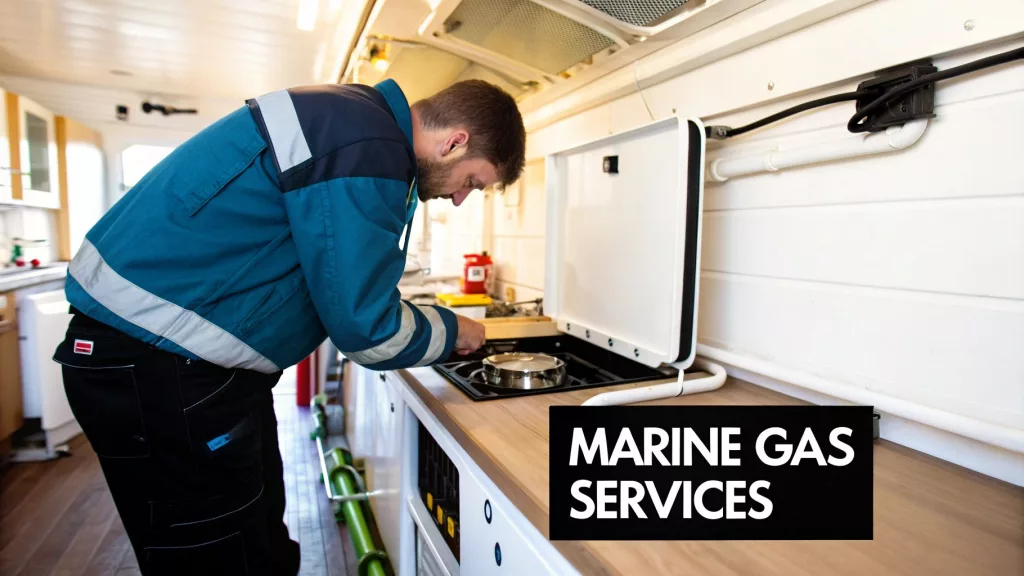
A proper boat gas engineer does a lot more than just fix a cooker that won’t light. Think of them as the guardians of your boat’s gas, diesel, and solid fuel systems. Their work is a careful mix of precision installation, painstaking safety checks, and skilled repairs, all geared towards keeping everything running smoothly and, most importantly, safely.
Their expertise is absolutely essential when you’re adding new kit. Whether it’s a high-efficiency Propex Malaga LPG water heater or a powerful Autoterm diesel air heater, a specialist ensures the job is done right from the start. They’ll handle everything from running copper pipework and securing fittings to building a compliant gas locker and guaranteeing proper ventilation—a non-negotiable factor in the tight confines of a boat.
New System Installations
Putting in a new LPG system isn’t a simple DIY job; it’s a complex task that demands meticulous planning to meet incredibly strict safety standards.
Gas Locker Construction: A good engineer will make sure the gas locker is completely sealed from the boat’s interior. It also needs to drain overboard, so any potential leak vents safely outside, not into your bilge.
Pipework and Fittings: They’ll use the right materials and, critically, secure all pipework against the constant vibration and chafing that comes with life on the water.
Appliance Connection: Each appliance is then hooked up with the correct fittings and rigorously tested to make sure it works as the manufacturer intended, with zero leaks.
The real aim of any installation isn’t just to get an appliance working. It’s to build a system that stays safe despite the constant movement, humidity, and vibration of a marine environment. This proactive mindset is what separates a true marine specialist from a standard domestic fitter.
Safety Inspections and Servicing
Annual safety checks are probably the most crucial service a boat gas engineer offers. This isn’t just a quick glance; it’s a deep-dive inspection designed to spot potential hazards before they become dangerous realities. The engineer will carry out a full system soundness test with a manometer, which can detect even the most minuscule of leaks.
They’ll also check every single appliance to ensure it’s operating correctly. This means making sure flames burn cleanly and that crucial safety devices, like flame failure mechanisms, are working exactly as they should. Beyond gas, these engineers are often skilled in the upkeep of fuel systems; you can find out more in a practical guide to cleaning petrol tanks.
Repairs and Certification
When something does go wrong, a qualified engineer has the diagnostic skills to track down the fault and carry out safe, effective repairs. After any installation, service, or major repair work, they can issue a Gas Safety Record.
This isn’t just a piece of paper. It’s an official document that’s often required for marina moorings, insurance policies, and the Boat Safety Scheme (BSS). It provides the documented proof you need to show your system has been professionally checked and is safe to use.
Passing Your Boat Safety Scheme Examination
The Boat Safety Scheme (BSS) examination is a mandatory check-up for most boats on our inland waterways, and you can bet the gas system will be a major point of focus. It’s really important to understand the difference between a BSS examiner and your boat gas engineer.
Think of the examiner like a driving test instructor. Their job is simply to assess whether your boat meets the required safety standards at that specific moment in time. They’re there to pass or fail you, not to fix things.
If they find an issue with your gas system, that’s your cue to call in a Gas Safe registered engineer with the right marine qualifications. They are the pros who do the actual work, turning a potential BSS failure into a straightforward pass.
Common Gas-Related BSS Failures
A lot of BSS failures are completely preventable with a bit of proactive maintenance. An experienced boat gas engineer knows exactly what the examiners are looking for and can sort out common problems long before your inspection is due.
Some of the most frequent gas-related failure points we see include:
Improper Gas Locker Construction: The locker has to be completely sealed from the boat’s interior. It also needs a drain that lets any leaked LPG vent safely overboard, not into your bilge where it can cause a massive hazard.
Incorrect Pipework: Using the wrong materials is an immediate red flag for any examiner. A classic example is seeing unsupported flexible hoses where rigid copper pipe is required.
Inadequate Ventilation: Every single gas appliance needs proper ventilation. This is crucial for safe combustion and to stop dangerous gases from building up in your cabin.
Proactively hiring a qualified engineer for an annual service isn’t just about ticking a maintenance box; it’s about setting your boat up to pass its BSS with flying colours. It turns what can be a stressful test into a simple formality.
The demand for engineers who properly understand these specific marine requirements is only going up, especially as boat systems get more complex. It’s clear that these specialised skills are more valuable than ever.
By working with a proper expert, you’re not just fixing problems as they appear—you’re investing in your own peace of mind. To get a better handle on how engineers and safety checks fit together, take a look at our guide on working with Boat Safety Scheme examiners. It really clarifies how these two essential roles work in tandem to keep you safe on the water.
Managing Diesel and Solid Fuel Systems
While LPG is often the go-to for cooking and hot water, many boats run on a mix of fuels to stay comfortable through the seasons. A truly versatile boat gas engineer is someone who knows their way around diesel and solid fuel systems, too. This kind of holistic expertise is invaluable; it means one trusted professional can look after every single heating and cooking appliance on your narrowboat or cruiser.
Having a single point of contact who understands how different systems interact in a tight marine space is a huge advantage. It stops you from having to juggle multiple tradespeople and ensures everything works together safely and efficiently.
Keeping Your Diesel Heater in Top Condition
Diesel air heaters, like the popular models from Autoterm, are a brilliant way to keep the cabin toasty. But a safe installation is everything. Any experienced engineer will zoom in on two critical areas: the exhaust and the fuel lines.
The exhaust fitting must be absolutely gas-tight and routed correctly to vent nasty fumes—including carbon monoxide—well away from the cabin. Just as important are the fuel lines. They need to be securely fastened to stop the boat’s natural vibrations from causing a leak, which could easily lead to a fire. Regular servicing is also a must to keep them burning cleanly and running efficiently, preventing soot build-up. For a bulletproof setup, a robust unit like the Autoterm 4D Diesel Air Heater is known for its durability.
A correctly installed diesel heater is a safe and reliable heat source. A poorly fitted one is a significant risk. The difference lies in the engineer’s specialist knowledge of marine safety standards, which go far beyond domestic requirements.
The Nuances of Solid Fuel Stoves
There’s nothing quite like the cosy, radiant heat from a solid fuel stove, and classics like the Morso Squirrel 1412 are a common sight on the cut. But this traditional comfort comes with some non-negotiable safety rules. The flue installation is, without a doubt, the most critical part of the job. It has to be perfectly sealed, well-insulated where it passes through the deck or roof, and fitted with the right collar to keep water out.
Proper ventilation is just as vital. A stove eats up oxygen as it burns, so you need an adequate supply of fresh air into the cabin to stop deadly carbon monoxide from building up. An engineer properly qualified in solid fuel systems will make sure every single part of the installation meets strict safety regulations, giving you complete peace of mind.
The skills for these systems are becoming more specialised, especially as the wider maritime engineering sector adapts to changes like the new 2025 F-Gas regulations. This is pushing up demand for engineers with current, relevant certifications. You can discover more insights about these regulatory shifts and see how they’re shaping the industry.
How to Choose the Right Boat Gas Engineer
Finding a reliable and properly qualified boat gas engineer can feel a bit like navigating in the fog. It seems daunting, but if you take a methodical approach, you’ll find the right person for the job. Your boat is a unique environment, and the engineer you hire absolutely must have the specific marine credentials to match. Rushing this decision is a risk you just don’t want to take.
First things first: you have to verify their Gas Safe registration. This is non-negotiable. Don’t just take their word for it—ask to see their ID card and then check it yourself on the official Gas Safe Register website. It is critical that their qualifications explicitly list both ‘LPG’ and ‘Boats’. An engineer missing either of these specialisms isn’t legally allowed to touch your boat’s gas system. Simple as that.
Creating a Shortlist
Once you’ve confirmed they are legally qualified to do the work, it’s time to dig a little deeper. A professional and trustworthy engineer will be more than happy to show you they’re competent and reliable.
Before you commit, make sure to:
Ask for Proof of Insurance: Always ask to see their public liability insurance certificate. This is your safety net, protecting you in the unlikely event that something goes wrong during the work.
Seek Out References: A good engineer leaves a trail of happy customers. Ask for references from other boaters or check for reviews and recommendations at local marinas and boat clubs. Word of mouth is powerful in the boating community.
Request a Detailed Quote: Never, ever settle for a verbal estimate scribbled on the back of a napkin. Ask for a written quote that clearly separates the cost of labour from the price of materials and parts. This kind of transparency helps you compare different engineers fairly and, crucially, avoids any nasty surprises down the line.
A detailed quote isn’t just about the price; it’s a reflection of an engineer’s professionalism. It shows they’ve properly assessed the job and are confident in their estimate, which should give you confidence in them.
Following these steps turns what could be a game of chance into an informed, sensible decision. Taking that extra bit of time to properly vet your engineer will give you complete peace of mind. For a closer look at what a high-quality installation involves, you can explore our guide to professional boat LPG gas installations.
Frequently Asked Questions
When it comes to marine gas safety, a few questions always seem to pop up. It’s completely understandable – this stuff is important. So, let’s clear the air and tackle some of the most common queries boat owners have.
How often should my boat’s gas system be checked?
You absolutely need to get your boat’s entire gas system serviced at least once a year.
Think of it as a comprehensive health check. It’s not just a quick once-over; a proper service involves a deep dive into every gas appliance, the gas locker itself, and all the pipework to make sure everything is safe, secure, and working as it should. An annual service is essential for your peace of mind, usually a non-negotiable for your insurance policy, and the single best way to sail through your BSS examination without a hitch.
Can I just use my normal domestic gas engineer on my boat?
In a word: no. Absolutely not. It might seem tempting, but it’s a massive mistake.
Your home gas engineer is almost certainly only qualified for natural gas systems in buildings that don’t move. Boats are a different world entirely. They use LPG (a different beast to natural gas), they’re in a constantly moving, corrosive marine environment, and they face unique challenges with vibration and ventilation.
Only a Gas Safe registered engineer who holds the specific ‘Boats’ qualification is legally permitted to work on your gas system. Getting anyone else to do it isn’t just unsafe, it’s against the law.
What’s the difference between a BSS Examiner and a Gas Engineer?
This is a really common point of confusion, but their jobs are worlds apart. It’s crucial to know who to call for what.
You can think of a BSS Examiner as being like an MOT tester for your boat. They inspect everything against a checklist and identify any issues that don’t meet the standard. The Gas Safe registered boat gas engineer, on the other hand, is the specialist mechanic who actually does the installation, servicing, and repair work required to meet (and hopefully exceed) those standards.
A Boat Safety Scheme (BSS) Examiner inspects your vessel to certify that it meets the required safety standards at that moment in time. If they flag a problem with your gas system during the inspection, your next call is to a qualified boat gas engineer to carry out the necessary repairs. The examiner checks the work; the engineer does the work.
Our Boat Gas Engineers
For expert installation, servicing, and repairs of your boat’s heating and cooking systems, it pays to trust the specialists. Contact Marine Heating Solutions to make sure your vessel is safe, compliant, and comfortable.
Yacht diesel heaters are tough, reliable bits of kit designed to pump out dry, consistent heat into your boat’s cabin, making them a must-have for anyone sailing around the UK. These units work by burning diesel fuel in their own sealed combustion chamber. A clever heat exchanger then warms up the cabin air, while all the nasty exhaust fumes are safely vented overboard. It’s a simple idea that delivers both comfort and safety when you’re out on the water.
Picture this: you wake up on a crisp autumn morning, but instead of that familiar damp chill you get on a moored boat, the cabin is already warm and dry. You can actually get up and make a brew without shivering. This isn’t some far-fetched luxury; it’s exactly what a good diesel heater brings to the table. For yacht, narrowboat and canal barge owners in the UK, these systems are so much more than just a nice-to-have – they’re essential for protecting your vessel and making the cruising season last longer.
The biggest win, of course, is the steady, controllable warmth. Forget about electric heaters that chew through your batteries or solid fuel stoves that need constant babysitting. A modern diesel heater is a ‘set-and-forget’ dream. This simple convenience completely changes the experience of being on board, turning what would be chilly evenings and frosty mornings into genuinely cosy, enjoyable times.
Protecting Your Investment from Damp and Mildew
Beyond just feeling comfortable, the dry heat kicked out by a diesel system is your best defence against the constant battle with damp. Condensation is the enemy on any boat, and it quickly leads to problems:
Mildew and Mould: Damp spots are a perfect breeding ground for mould, which will ruin upholstery, headlinings, and anything else it gets its hands on.
Corrosion: Moisture makes corrosion happen faster, putting your expensive marine electronics and electrical connections at serious risk.
Musty Odours: A damp boat just has that unpleasant, musty smell that’s almost impossible to get rid of.
A yacht diesel heater keeps warm, dry air circulating, actively fighting off condensation. This doesn’t just keep the inside of your boat looking and smelling nice; it protects thousands of pounds worth of equipment.
Think of it this way: a diesel heater is basically a 24/7 dehumidifier. By keeping the internal environment dry and stable, it’s actively safeguarding the structural integrity and value of your vessel, especially during those long, quiet winter moorings.
Extending Your Boating Season and Enhancing Safety
With a reliable heater installed, the UK boating season doesn’t have to end in September. You can comfortably plan trips for early spring and late autumn, getting out on the water when it’s quieter and enjoying the scenery without freezing.
This longer season brings a safety boost, too. A warm, dry crew is a much more alert and effective crew. Being cold and damp quickly leads to fatigue and poor decisions – two things you really don’t want when you’re navigating chilly coastal waters or inland waterways. Keeping the cabin comfortable ensures everyone on board stays rested and sharp.
The numbers back this up. In 2023, diesel heaters were fitted in nearly 65% of all marine heater installations on UK leisure vessels, a statistic that speaks volumes about how valuable they are. This trend is particularly strong in places like Scotland, where having dependable heating is simply non-negotiable. You can discover more insights from this marine heating report.
There’s a reason brands like Eberspacher and Webasto have become the gold standard in the marine world. They’re incredibly efficient, run quietly, and have a proven track record for reliability. To see a curated selection of systems that are perfect for boats, you can check out our complete guide on diesel heaters for boats. Putting a quality unit in your vessel truly turns it into a craft for all seasons.
Understanding How Your Diesel Heater Works
A yacht diesel heater might look a bit intimidating at first glance, but how it works is surprisingly simple. More importantly, it’s built from the ground up with one thing in mind: safety. These systems are designed to give you clean, dry heat without ever letting dangerous exhaust fumes into your cabin. Let’s break down how it cleverly turns diesel from your tank into cosy warmth.
The process kicks off the moment you switch the heater on. A small, precise fuel pump starts sipping a tiny amount of diesel from your boat’s main tank. You’ll hear a characteristic light ticking sound, which is perfectly normal. It’s just the pump carefully measuring out the fuel before sending it to the heater unit.
Inside the heater is where the real work happens. The diesel gets sprayed into a burner chamber and mixed with air that’s been drawn in from outside the boat. A glow plug—which gets incredibly hot for a short burst during start-up—ignites this fuel-air mixture. This controlled burn takes place inside a completely sealed metal box.
The Heart of the System: The Heat Exchanger
The absolute core of the heater’s design is the heat exchanger. The best way to think of it is like a radiator sealed inside another radiator. The extremely hot gases from the combustion process pass through the inner chamber, heating up the metal fins of the exchanger.
Crucially, these exhaust gases are kept completely separate from the air in your cabin. A powerful fan pulls in cool air from inside your boat, blows it over the hot outer surfaces of the heat exchanger, and then pushes this newly warmed air out through ducting into your living spaces. The combustion gases, having done their job and given up their heat, are then channelled safely outside through a dedicated exhaust pipe.
This complete separation is the single most important safety feature of any marine diesel heater. At no point do the toxic exhaust fumes ever mix with the clean, warm air circulating in your cabin. It’s a closed-loop system designed to give you only the heat, never the harmful by-products.
This infographic shows just how much a heater can improve your boating experience, from sailing later in the season to protecting the boat itself and keeping everyone on board comfortable.
As you can see, the benefits are all connected—a longer season means better protection for the vessel and a more comfortable crew.
Key Components and Their Roles
To really get to grips with your system, it helps to know the main players and what they do. Each part has a specific job that contributes to the heater’s performance and reliability.
Fuel Dosing Pump: This isn’t just any old pump; it delivers precisely measured pulses of fuel. The frequency of its ‘ticks’ controls the heat output, making it vital for efficient running.
Combustion Air Fan: This fan is responsible for pulling external air into the burner for ignition. Its speed is managed by the unit’s electronics to maintain the perfect fuel-to-air ratio for a clean burn.
Glow Plug/Pin: This is the spark. It’s a high-amperage component that’s only used for the first couple of minutes during start-up to get the fuel ignited. Once the flame is stable, it switches off.
Cabin Air Fan: This is the fan you hear gently whirring away when the heater is running. Its job is to circulate air through the boat, spreading the warmth nice and evenly.
Electronic Control Unit (ECU): The ‘brain’ of the operation. The ECU monitors all the sensors (like temperature and flame detection) to safely manage the entire process, from start-up to shutdown.
Knowing how these parts work together gives you the confidence that your system is running as it should. If you’re looking to install a new system, exploring the range of high-quality diesel air heaters we offer will give you a clear idea of the reliable options available. This knowledge is your first step towards comfortable, year-round boating.
Choosing the Right Heater for Your Yacht
Picking the perfect diesel heater for your yacht or narrowboat isn’t just about choosing a reputable brand. It’s about matching the heater’s power and features to your specific boat, ensuring you stay warm without burning through fuel unnecessarily. The goal is to find that sweet spot: a heater powerful enough to warm the whole boat on a chilly night, yet efficient enough to sip fuel and run quietly in the background.
Getting this right from the outset will save you a world of hassle later on. An undersized heater will run flat-out, constantly struggling to keep up without ever making the cabin truly comfortable. On the other hand, a unit that’s far too powerful will cycle on and off all the time, which leads to needless wear and tear, higher fuel use, and a buildup of carbon in the burner.
Calculating Your Vessel’s Heating Needs
The single most important factor when choosing a yacht diesel heater is its heat output, which is measured in kilowatts (kW). A simple and surprisingly effective way to estimate the power you’ll need is by looking at your vessel’s internal volume.
As a reliable rule of thumb, marine heating engineers typically allow 1kW of heating power for every 10 cubic metres of internal space.
To work out your boat’s volume, just measure its length, width, and average headroom in metres, then multiply them together (Length x Width x Height = Volume in m³). So, for a 10-metre yacht with a 3-metre beam and 2 metres of headroom, the volume is roughly 60 m³. Based on our rule, this boat would need a heater with around 6kW of power.
But this calculation is just a starting point. You’ve also got to think about a few other things:
Insulation: Is your vessel well-insulated, or is it an older GRP hull with just a thin lining? Poor insulation means heat escapes quickly, so you might need to bump up your calculated power requirement by 20-30%.
Layout: An open-plan saloon is much easier to heat than a layout with multiple separate cabins. More cabins mean more ducting is needed, which can lead to more heat being lost along the way.
Usage: Where and when will you be cruising? The Scottish Highlands in winter demands a lot more from a heater than the Norfolk Broads in spring.
Beyond Kilowatts: Key Features to Consider
While the kW rating is crucial, other features are just as vital for comfort and convenience. Modern heaters from established names like Eberspacher and Webasto come with a range of options that make a real difference to life on board.
Take thermostatic controls, for instance. A basic rotary dial does the job, but a modern digital controller lets you set a precise temperature. The heater then automatically adjusts its output to maintain that temperature, often running quietly on a low setting for hours and saving a significant amount of fuel.
You should also think about the number of outlets. A single outlet might be fine for a small, open-plan cabin, but on a multi-cabin boat, you’ll need a heater powerful enough to push warm air through a whole network of ducts. Plan out where you want your warm air outlets—in the saloon, each sleeping cabin, and maybe even the heads—to get heat distributed evenly.
Don’t underestimate the importance of quiet operation. The soft whir of a fan is far preferable to the constant ticking of a noisy fuel pump. High-quality installation, including mounting the fuel pump on a flexible bracket, makes a world of difference to a peaceful night’s sleep.
Comparing Popular Eberspacher and Webasto Models
To give you a better idea of what’s out there, let’s look at some of the most popular and reliable marine diesel heaters on the market. These models are proven performers in the UK marine environment and are choices we frequently install for our clients.
Eberspacher & Webasto Heater Model Comparison
This table compares some common models from the two biggest names in the game, helping you see which unit might be the right fit based on your boat’s size and heating needs.
A versatile mid-range option with a ‘boost’ function for rapid heating.
Eberspacher Airtronic M2 D4L
0.9 – 4.0
32 – 40 ft
0.11 – 0.51
Offers a very wide power range, making it highly efficient for varied conditions.
Webasto Air Top Evo 55
1.5 – 5.5
38 – 45 ft
0.18 – 0.67
High-power output suitable for larger vessels or those cruising in colder climates.
By taking the time to properly assess your vessel’s size, layout, and insulation, and thinking about which features will genuinely improve your time on the water, you can confidently choose a heater that will become a dependable and efficient crew member for many seasons to come.
Navigating a Safe and Effective Installation
A perfectly chosen yacht diesel heater is only half the battle; it’s the installation that truly makes or breaks its performance. A professional job guarantees safety, efficiency, and quiet warmth. A poor one? At best, it’ll be inefficient. At worst, it’s downright dangerous.
Whether you’re a hands-on skipper planning a DIY project or you’re overseeing a marine engineer’s work, getting to grips with the core principles of a safe installation is non-negotiable.
Success really comes down to careful planning. I’m talking about thinking through the location of the unit, the route for the exhaust, and where the fuel and air lines will go. Every single decision you make at this stage has a knock-on effect on the heater’s reliability and, most critically, the safety of everyone on board.
Pinpointing the Perfect Heater Location
Your first big decision is choosing where to mount the heater itself. The ideal spot is always a dry, well-ventilated area that’s out of the way but still accessible for when you inevitably need to do some maintenance.
For most boats, a cockpit locker, lazarette, or a dedicated space within the engine bay is usually the perfect home for it.
When you’re scouting for a location, keep these points front of mind:
Combustible Materials: You absolutely must have enough clearance around the heater, especially near the hot air outlet and the exhaust port. A minimum of 8-12 inches from any flammable surfaces is the standard rule to live by.
Ventilation: The heater needs to breathe. It requires a constant supply of fresh air for combustion, so the space it’s in can’t be airtight.
Ducting Runs: Think about the path of least resistance. Position the heater to allow for the straightest and shortest possible runs for your hot air ducting. Long, winding paths with lots of sharp bends will kill your airflow and slash the heater’s efficiency.
The Exhaust System: A Critical Safety Element
If there’s one part of the installation to be obsessive about, it’s the exhaust. This is the system that safely vents toxic gases, including carbon monoxide, overboard. There is absolutely zero room for error here.
A safe exhaust setup has a few non-negotiable parts. It must go through the hull or superstructure using a purpose-built, marine-grade stainless steel skin fitting. The exhaust pipe itself has to be properly lagged with high-temperature insulation to stop it from scorching anything nearby or, worse, causing a fire.
The golden rule for marine exhaust installation is simple: ensure a continuous downward slope from the heater unit all the way to the skin fitting. This makes it impossible for seawater to track back up the pipe and flood the heater, which would be a catastrophic failure.
Fuel Lines and Ducting for Optimal Performance
With the heater and exhaust locations sorted, the final pieces of the puzzle are the fuel supply and the air ducting.
That little ticking fuel pump should be mounted as close to the fuel tank as you can get it, and always on a flexible rubber bracket. If you mount it directly to a rigid bulkhead, you’ll hear that tick-tick-tick vibrating through the entire hull. It gets annoying, fast.
Routing the fuel line also needs a bit of care. You have to avoid any kinks or low spots where air bubbles could get trapped. Make sure it’s secured well away from hot exhaust components and any sharp edges that could chafe it over time.
Finally, planning your ducting is what ensures you get balanced heat distribution. Think strategically about where to put the outlets to deliver warm air to key areas—the main saloon, sleeping cabins, and even the heads to help keep things dry. Using good quality, insulated ducting is a must; it minimises heat loss and makes sure the air arriving in the cabins is as warm as possible.
While a DIY approach is certainly possible, the complexities involved, especially with the exhaust, often make professional help a very wise investment. For anyone weighing up their options, looking into a dedicated diesel heater installation service can provide invaluable peace of mind that the job is done to the highest safety standards.
Keeping Your Heater Reliable for the Long Haul
Your boat’s diesel heater is a tough bit of kit, but just like the main engine, it needs a bit of TLC to make sure it fires up without a fuss. A little proactive maintenance is the secret to a long, trouble-free life, helping you sidestep a chilly failure on a damp evening when you need that warmth the most. By getting into a simple, consistent routine, you’ll seriously extend your heater’s lifespan and keep it running efficiently.
A good maintenance schedule doesn’t have to be a massive chore. It’s really just about building a few good habits to stop the common problems dead in their tracks.
The One Maintenance Habit That Matters Most
If you take just one thing away from this section, make it this: run your heater on its highest setting for at least 30 minutes every single month. Yes, even in the middle of summer. This simple act is your best defence against carbon and soot building up inside the burner chamber.
When a heater just trickles along on a low setting for ages, it never gets hot enough to burn the fuel completely. This is what leads to those sooty deposits that eventually clog up the burner gauze and mess with the ignition. A monthly blast on high power gets the unit scorching hot, burning off all that gunk and basically giving itself a good clean out.
Think of this monthly “de-coke” as your first line of defence. It costs you next to nothing in fuel but can prevent the vast majority of those annoying start-up failures and performance issues caused by carbon buildup.
Pre-Season and End-of-Season Checks
A more thorough look-over at the start and end of your main boating season will help you catch any potential gremlins. These are straightforward visual checks that anyone can do.
Your Annual Checklist:
Inspect the Exhaust: Run your eye (and hand) along the entire length of the exhaust pipe, from the heater right to the skin fitting. You’re looking for any hint of corrosion, loose connections, or damage to the lagging. A secure, gas-tight exhaust is absolutely vital for safety.
Check Fuel Lines: Look over the fuel line for any cracks, chafing, or tell-tale signs of leaks, especially around the joints and connectors. Give the clips a wiggle to make sure they’re tight.
Inspect Air Intakes: Make sure the combustion air intake and the cabin air return vents are totally clear. Dust, cobwebs, or a stray bit of kit can easily block them up and seriously hamper performance.
Test Run: Fire the heater up and let it run for a good while. Listen for any strange noises and feel for a strong flow of warm air coming from all the outlets.
For a wider view on this kind of structured upkeep, it can be useful to look at a comprehensive HVAC preventive maintenance checklist. The core principles of routine checks are pretty universal for any heating system.
Common Service Items to Keep an Eye On
While a good quality heater is built to last, a few bits are considered service items that will eventually wear out after hundreds of hours of use. The two most common culprits are the glow plug and the burner gauze.
A failing glow plug will usually cause start-up problems. The heater will try to fire, fail, and you’ll see puffs of white smoke from the exhaust. A clogged burner gauze can cause similar symptoms, or just a smoky, weak burn. Honestly, keeping spares for both on board is a smart move, especially if you’re heading off on a longer cruise.
The average lifespan of a diesel heater on a UK boat is about 10 years, though newer models with better tech can often push that to 15 years. As for costs, you can expect annual maintenance in the UK to be somewhere between £150 to £300 – a small price to pay for reliable heat. For a deeper dive into what a professional service entails, our guide on servicing diesel-burning appliances on boats has all the details.
Your Questions Answered
Even with the best planning, a few practical questions always come up when you’re thinking about fitting a new diesel heater. It’s one thing to understand the theory, but it’s another to know how it will actually work day-to-day on your own boat.
Let’s clear up some of the most common queries we hear from boat owners. Getting these details sorted will help you feel confident that you’re making the right choice and know exactly what to expect.
How Much Power Does a Diesel Heater Actually Use?
This is the big one for most boaters. Your battery bank is your lifeline when you’re off-grid, so any new piece of kit has to be efficient. The good news? Modern diesel heaters are surprisingly light on power once they’re up and running.
The initial start-up is the most power-hungry part of the cycle. To get the glow plug red hot for ignition, a typical 12V heater will draw around 8 to 10 amps. But this burst only lasts for a couple of minutes.
Once the flame is stable and the unit is running, the glow plug shuts down. From then on, the power consumption plummets to just 1 to 2 amps. This tiny draw is only needed for the fuel pump and the circulation fan, a load that a decent house battery bank can handle for hours on end without breaking a sweat.
Can I Run It on Red Diesel?
Yes, absolutely. In fact, they’re designed for it. Heaters from reputable brands like Eberspacher and Webasto sold in the UK are built to run perfectly on red diesel (gas oil), the same fuel that powers most inboard engines. This means you can usually tee into your main fuel line without needing a separate tank.
The real enemy of your diesel heater isn’t the colour of the fuel, but its quality. Water contamination is the number one cause of heater breakdowns. Your best line of defence is a good quality, water-separating fuel filter installed on the heater’s supply line. It’s a simple, inexpensive way to protect your investment.
Are They Noisy?
Forget the clattering old heaters you might remember from years ago. Modern systems are engineered to be whisper-quiet, so they won’t spoil the peace of a quiet evening at anchor.
You’ll generally only notice two sounds:
A low whirring from the fan circulating the warm air. If you install the main heater unit in a locker or engine bay, you’ll barely hear this in the cabin.
A gentle, rhythmic ticking from the fuel pump. This is easily solved by mounting the pump on a flexible rubber bracket. This stops the vibrations from resonating through the bulkhead, effectively silencing it.
What’s the Difference Between an Air Heater and a Water Heater?
So far, we’ve focused on forced-air diesel heaters. These are by far the most common choice for most boats because they’re simple, effective, and relatively easy to install. They work like a fan heater, pushing warm air directly into the cabins through ducting for instant heat.
The alternative is a hydronic or water-based system. Think of this as a miniature central heating system, just like you have at home. It heats a water/antifreeze mix that gets pumped through a network of pipes to small radiators or fan-assisted matrix units in each cabin.
The big advantage of a hydronic system is that it can also heat your domestic hot water via a calorifier. They provide a silent, gentle ‘wet heat’ and are often the go-to for larger vessels or full-time liveaboards, but the installation is much more complex and expensive.
Our Sevices
For expert advice on choosing, installing, or servicing the perfect heating solution for your vessel, trust the certified engineers at Marine Heating Solutions. Explore our full range of products and services and get in touch for a quote today!
A proper canal boat central heating system isn’t just a nice-to-have; it’s the beating heart of a comfortable, year-round life on the cut. It’s what turns a simple narrowboat into a warm, inviting home, no matter how grim the weather gets outside.
This guide will walk you through the big decisions, putting the most popular systems—diesel, solid fuel, and LPG—head to head. We’ll get into how each one actually works, what you can expect to pay to run them, and which is going to be the best fit for you and your boat.
Once you get a handle on the core differences, you’ll be able to confidently pick a boat heating system that makes sense for your boat’s size, how you plan to use it, and your budget.
A well-chosen heater is the difference between simply owning a boat and truly living aboard. It’s what turns those chilly winter evenings into properly cosy nights in your floating home.
Let’s make sure your boat stays a warm sanctuary, all year long.
Comparing the Top Three Canal Boat Central Heating System Types
Let’s be honest, not all heating systems are created equal, and the right choice for your canal boat depends entirely on how you plan to use it. With over 80,000 leisure boats on the UK’s waterways, modern comforts are no longer a luxury—they’re expected. If you’re curious about how we got from basic working vessels to today’s floating homes, this history of UK canals is a fascinating read.
When it comes to central heating, your main options really boil down to three distinct types.
You can think of a diesel system as a compact, dedicated boiler for heating and providing hot water via a calorifier. An LPG system can be much like your boiler at home, just cleverly adapted for life afloat. Then you have the classic solid fuel stove with a back boiler—the traditional heart of the boat, a rustic fireplace that also happens to heat your radiators.
Heating System Comparison At a Glance
To make things a bit clearer, here’s a quick rundown of the main systems side-by-side. Think of this as your cheat sheet for understanding the core differences at a glance.
Liveaboards seeking a traditional feel and off-grid heat source.
Cosy, dry heat and independence from electrical systems.
Each of these has its place on the cut. Your job is to figure out which one aligns best with your life on the water.
Diesel-Fired Heating: The Modern Choice
For a lot of modern narrowboat owners, diesel central heating has become the undisputed champion. It’s prized for being incredibly efficient and just so convenient. Think of it as your boat’s own miniature, fully automated boiler.
These clever bits of kit simply tap into your main engine’s fuel tank, burning a tiny amount of diesel to heat up a water circuit. This hot water then gets pumped through radiators to warm your cabin, and also through a calorifier to give you hot water at the taps. The whole show is run by a simple control panel, often with a programmable thermostat for that brilliant ‘set-it-and-forget-it’ warmth.
The biggest win here is reliability. You’ve already got a massive fuel tank on board, so a diesel system gives you powerful, consistent heat at the push of a button, no matter what the weather is doing outside.
The process itself is surprisingly straightforward, and these compact units can really kick out some serious heat. If dependable performance is what you’re after, taking a look at the various diesel boat heating options is a sensible next step to keep your boat cosy all year round.
Solid Fuel Stoves: The Heart of Your Boat
For a lot of boaters, there’s nothing quite like the gentle glow of a solid fuel stove. It’s the very definition of cosy narrowboat life. But it’s more than just a beautiful focal point; fit one with a back boiler, and it can power your entire canal boat central heating system.
This clever setup uses the heat from your fire to warm up water, which then gets pumped around your radiators and through your calorifier for hot taps. It’s a system that creates a deep, dry heat that really gets into the bones of the boat, making it perfect for continuous cruisers and anyone wanting a proper, traditional off-grid life.
This way of life is definitely hands-on. You’ll be sourcing and storing fuel, and the daily ritual of lighting the fire becomes part of your routine. It’s a rewarding process that connects you to your boat in a really fundamental way.
Of course, with any fire, safety has to be the top priority. A properly installed flue and a working carbon monoxide alarm are completely non-negotiable. If you’re curious about the different models out there, you can take a closer look at our post about narrowboat wood burning stoves or browse our Boat Appliances section.
Integrating Your Engine for Free Hot Water
One of the cleverest bits of design on a narrowboat is the ability to generate ‘free’ heat just by running your engine. As you’re cruising along the cut, your engine is producing a massive amount of waste heat. Instead of just letting it dissipate, a well-designed system can capture that energy and give you a tank full of piping hot water without burning any extra fuel.
The magic happens thanks to a piece of kit called a calorifier. You can think of it as a highly insulated hot water tank that also works as a heat exchanger. Hot coolant is diverted from the engine and pumped through a coiled pipe inside the calorifier, transferring its heat to your domestic water supply as you chug along.
With an estimated 8,580 narrowboats being used as permanent homes in the UK, making the most of every bit of energy is crucial for comfortable living, especially through the winter months.
Many modern calorifiers now come with a ‘twin coil’ system. This is a game-changer, as it lets you heat your water from two different sources. You can use your engine’s heat when you’re on the move, and then switch over to your diesel heater or a solid fuel stove’s back boiler unit when you’re moored up. It’s this kind of integration that makes for a truly efficient off-grid home.
Looking After Your System: Safety and Maintenance
Getting your canal boat central heating system fitted and then keeping it in good nick is about more than just staying warm. It’s about safety, efficiency, and making sure the whole setup lasts as long as it should. When it comes to diesel and gas systems, we can’t stress this enough: get a professional to install it. It’s the smartest money you’ll spend, avoiding terrifying risks like fuel leaks or, worse, carbon monoxide poisoning.
Everything on your boat, especially fuel lines, exhausts, and ventilation, needs to meet the Boat Safety Scheme (BSS) standards. This isn’t just red tape; it’s a non-negotiable part of keeping you safe.
Your annual to-do list should always include a few key checks. Clean out the fuel filters, top up the antifreeze if needed, and give the flue pipes a good inspection for any soot build-up or blockages. A little bit of regular attention keeps the system running sweet, saves you a bit on fuel, and gives you that all-important peace of mind.
And while we’re on the topic of safety, it’s not just about the heating system itself. Every boater should know how to operate a fire extinguisher – it could make all the difference in an emergency.
Finally, a CO alarm is an absolute must-have on any boat with appliances that burn fuel. It’s a simple, cheap bit of kit that protects you, your family, and your boat from dangers you can’t even see.
Common Canal Boat Heating Questions Answered
So, what are the big questions people ask when it comes to heating their boat? Let’s dive into a few of the most common ones we hear.
How Much Does It Cost to Run?
This is the classic “how long is a piece of string?” question. The running costs really do hinge on the system you choose and how you use it.
Diesel systems are generally pretty efficient and their fuel costs are predictable, making budgeting a bit easier. Solid fuel can be incredibly economical, especially if you can source your wood or coal cheaply, but LPG often works out as the most expensive option for keeping your boat warm all the time.
Can I Fit It Myself?
While plenty of experienced boaters with good practical skills will happily tackle fitting a solid fuel stove, we’d always recommend getting a professional in for diesel and gas systems. It’s not just about getting it working; it’s about making sure it’s safe.
Proper installation is critical to meet the Boat Safety Scheme (BSS) standards. Getting it wrong can lead to some really serious risks, like carbon monoxide leaks, which you absolutely don’t want to mess with.
What’s Best for a Continuous Cruiser?
For those living on the cut full-time, flexibility is king. That’s why many continuous cruisers swear by having two different heating systems. A popular and effective setup is a solid fuel stove paired with a diesel heater.
The stove gives you that constant, dry, off-grid heat that’s so lovely on a cold winter’s day. Then, the diesel heater offers quick, automated warmth on demand—perfect for chilly mornings or when you get back to the boat late. This combination gives you brilliant flexibility, covering all bases no matter the weather.
What Canal Boat Central Heating Systems Do You Install?
For professional advice on the best canal boat central heating system for your vessel, contact the experts at Marine Heating Solutions. Find out more about the heaters we sell by browsing our Boat Appliances section, and get in touch for a quote today!
Living on a boat is an incredible experience, blending the comforts of home with the joys of a hobby. But it’s a two-sided coin. The dream of freedom on the water is very real, but so is the constant need for attention and upkeep. It demands far more hands-on maintenance than your average house on land, so before you take the plunge, let’s get a real feel for what you’re signing up for when looking for a boat for living.
There’s a certain magic to waking up to the sound of ripples against the hull and seeing wildlife just outside your window. It’s a liberating lifestyle. However, that romantic charm has to share space with the practical realities of daily chores. You’ll find yourself balancing the serenity of it all with regular hull checks and engine maintenance.
One of the best parts of living on the cut is the community. Your neighbours often become a sort of extended family, always ready to share tools, advice, or just a cup of tea. That said, life on the move, especially near busy locks and bridges, requires a good deal of flexibility in your schedule.
Costs can be a bit of a moving target. You’ve got your regular outgoings like fuel, licence, and mooring fees, but it’s the unexpected repairs that can really test your savings. A smart budget isn’t just about the planned upgrades; it’s about having a healthy buffer for those emergency fixes that always seem to pop up.
And then there’s the paperwork. Safety regulations, enforced by authorities like the Canal & River Trust, are there to protect everyone, but they do mean staying on top of your admin. From the Boat Safety Scheme (BSS) certificate to gas checks, compliance is absolutely non-negotiable. A huge part of this is ensuring you have reliable, safe heating and plumbing systems installed.
The Liveaboard Lifestyle at a Glance
Choosing to live on a boat is a significant lifestyle shift. To help you see the bigger picture, here’s a quick rundown of the highs and lows you can expect.
Aspect
Potential Advantages
Potential Challenges
Freedom & Mobility
Unrivalled ability to change your scenery and explore the UK’s beautiful waterways at your own pace.
Constant need for logistical planning, from navigating routes to finding services like water points and pump-outs.
Community
A unique, tight-knit community where mutual support and camaraderie are part of daily life.
The close quarters can sometimes feel a bit intense, and privacy might be less than you’re used to.
Financials
Potentially lower living costs compared to traditional housing, with no council tax.
Costs can be unpredictable, with licence fees, fuel, and sudden, expensive repairs always a possibility.
Maintenance
A fantastic opportunity to become self-sufficient, learn new DIY skills, and truly make your home your own.
The maintenance is relentless. From engine care to blacking the hull, there is always something that needs doing.
Ultimately, life afloat is a constant trade-off. It’s about weighing the incredible freedom against the very real responsibilities that come with it.
Matching Your Boat to Your Lifestyle
The first big decision is the boat itself, and this really comes down to weighing size against manoeuvrability. A classic narrowboat, for instance, is perfectly designed to slip through the UK’s narrow locks and canals. On the other hand, a widebeam barge feels much more like a floating flat, offering heaps of space but limiting where you can travel. Think of it as choosing between a nimble city car and a spacious SUV – each has its place, but they aren’t interchangeable.
The trend towards living afloat is growing. According to the Canal & River Trust, the number of boats without a permanent home mooring has been steadily increasing, highlighting that this is no longer just a niche lifestyle.
For a deeper dive into the specifics of traditional narrowboats, including different hull types, engine options, and popular layouts, have a look at our detailed guide on narrowboat living. It’s packed with information to help you figure out if this classic style of boat is the right fit for you.
Before you go any further, ask yourself a few honest questions:
Do I prize mobility and freedom more than having lots of living space?
Am I genuinely prepared to get my hands dirty with routine engine and hull care?
Have I realistically budgeted for the ongoing costs of heating, plumbing, and licences?
If you can confidently say yes to these, then a life on the water might just be the best decision you ever make, offering breathtaking views and a wonderfully supportive community. If not, it’s better to realise it now and explore other options that might be a better fit.
Choosing Your Liveaboard Vessel
Picking the right boat to live on is a lot like choosing a house – it’s a massive personal decision that has to match your lifestyle, your wallet, and what you dream of doing. Here in the UK, that choice usually comes down to two main players: the classic, skinny narrowboat or the much roomier widebeam barge. Each one offers a completely different way of life on the water.
You can think of a narrowboat as the waterways’ answer to a classic terraced house. It’s got charm and character, and it’s built perfectly for its surroundings—the historic UK canal network. Its slender build, usually 6 feet 10 inches wide, means it can squeeze through just about any canal, lock, and tunnel in the country. That gives you an incredible amount of freedom to explore.
A widebeam, on the other hand, is more like a modern, open-plan flat. Typically between 10 to 12 feet wide, it gives you a feeling of space that’s remarkably close to a home on dry land. All that extra width means you can have more normal furniture, bigger kitchens, and a general vibe that feels a lot more domestic.
Narrowboat: The Go-Anywhere Home
The biggest draw of a narrowboat is its all-access pass to the canal system. If your dream is to be a continuous cruiser and see every last mile of the UK’s canals, a narrowboat is pretty much a no-brainer. They are so much easier to handle, making tight turns and navigating busy spots a whole lot less stressful.
Of course, that freedom comes at a price: living space. The layout is one long line, so rooms just flow from one to the next. This forces you to be smart with storage and embrace a more minimalist way of living. Life on a narrowboat will make you a master of organisation.
Widebeam: The Floating Apartment
A widebeam gives you a level of comfort and space that a narrowboat just can’t touch. That extra few feet of width totally changes the living area. You can have freestanding sofas, a proper dining table, and even separate rooms that don’t feel like you’re in a hallway. For anyone planning to stay put for longer stretches or work from their boat, this extra room can make all the difference to your daily life.
The massive downside, however, is that your travel is seriously restricted. A lot of the UK’s older canals, especially up in the Midlands and the North, have narrow locks and bridges a widebeam simply won’t fit through. Your cruising grounds will be limited to the wider rivers and certain sections of the canal network. That’s a huge factor to weigh up if exploring is a top priority for you.
At its heart, the decision is a straight trade-off between freedom and space. A narrowboat opens up the entire network but makes you live in a corridor. A widebeam gives you home-like comfort but ties you to a much smaller part of the waterways.
Key Technical Considerations
Beyond just narrow versus wide, a few other key things will shape your decision.
Hull Material: The overwhelming majority of canal boats in the UK are built from steel. It’s tough, it lasts, and it’s not too difficult to get repaired. The thickness of the steel—for example, a 10mm base plate and 8mm sides—is a really good sign of the boat’s quality and how long it’s likely to last.
Engine Type: Most modern boats on the inland waterways run on reliable, water-cooled diesel engines from brands like Canaline, Barrus, or Vetus. These are the workhorses of the canals, famous for being durable and pretty good on fuel.
Interior Layout: You’ll generally find two main layouts. The traditional layout puts the bedroom at the bow (front) of the boat, with the kitchen and living area at the stern, right where you steer from. A reverse layout flips that around, putting the social kitchen and living space at the back, which is great if you like to entertain or chat with people as you cruise.
Plumbing is another one of those critical systems you need to get your head around. The type of toilet you have, for instance, makes a big difference to your daily routine. You can dig into the different options in our guide on choosing the right toilet for a boat, which covers everything from simple cassette toilets to the more involved pump-out systems. Getting these on-board essentials right is the key to making sure your floating home is both practical and comfortable.
Budgeting for Your Life Afloat
The dream of living on a boat is incredibly liberating, but turning that dream into a sustainable reality comes down to a solid financial plan. The real cost of life on the water goes far beyond the initial purchase price of the boat itself. To budget realistically, you need to get to grips with a mix of fixed, unavoidable expenses and variable costs that can shift with the seasons and how much you travel.
Getting a handle on these ongoing outgoings is the secret to a stress-free life afloat. Just like a homeowner has to budget for council tax and utilities, a boater needs to plan for licences, insurance, and routine maintenance. If you let these slide, the dream can quickly turn into a massive financial headache.
Being honest about the finances is crucial. We all feel the pinch from time to time, and the boating community is no different. These pressures have sometimes made it difficult for people to keep up with licensing, which has prompted the Canal & River Trust to increase its welfare support for boaters who need a bit of help with costs.
Mandatory Annual Costs
Right, let’s talk about the non-negotiables. These are the expenses that form the bedrock of your annual budget – the costs you absolutely must cover every year to legally keep and use your boat on the UK’s inland waterways.
Canal & River Trust Licence: Think of this as your permit to cruise the canals and rivers managed by the Trust. The fee is based on the length and width of your boat, and you’ll find that widebeams cost a fair bit more than narrowboats.
Boat Safety Scheme (BSS) Certificate: This is the boating equivalent of a car’s MOT. It’s a mandatory safety inspection required every four years to check that your boat’s fuel, gas, and electrical systems are safe. While it’s only every four years, it’s smart to put money aside for it annually.
Insurance: You’ll need at least third-party liability insurance to get your licence in the first place. Most people living aboard opt for more comprehensive cover that protects the boat’s structure and contents, much like you would with home insurance.
Variable and Maintenance Expenses
Beyond the fixed costs, your day-to-day spending will ebb and flow depending on how you live and cruise. These variable expenses are the ones that need careful tracking and a bit of forward-thinking.
Moorings are a classic example. If you decide to be a “continuous cruiser,” you won’t have permanent mooring fees, but you are required to move your boat at least every 14 days. On the other hand, securing a permanent spot in a marina gives you a home base with handy services like electricity and water. This convenience, however, can set you back several thousand pounds a year, especially in popular areas.
Think of your budget as a living document, not a one-time calculation. Regularly reviewing your spending on fuel, gas, and maintenance will help you adapt to changing costs and avoid unwelcome financial surprises.
Here are some of the other essential variable costs to plan for:
Fuel (Diesel): This is what powers your engine for getting about, but on many boats, it also runs the central heating and hot water. Expect your usage to jump up in the winter and during long journeys.
Gas (LPG): Propane or butane gas is the standard for cooking on board. A typical 13kg bottle can last a good few months, but it all depends on how much you’re cooking.
Engine Servicing: Your boat’s engine is just like a car’s – it needs an annual service with oil and filter changes to keep it chugging along reliably.
Hull Blacking: This is a big one. Every 3-4 years, your boat needs to be lifted out of the water so the steel hull can be painted with bitumen (a process known as ‘blacking’). It’s a vital job that protects the hull from rust and corrosion, and it’s one of the biggest single maintenance costs you’ll face.
Here is a table breaking down some of the typical annual costs you might encounter. Remember, these are just estimates, and your actual spending will depend on your boat, location, and lifestyle.
Estimated Annual Costs for a Liveaboard Boat
Expense Category
Estimated Annual Cost Range (£)
Key Considerations
CRT Licence
£600 – £1,500+
Depends on boat length and width. Widebeams are more expensive.
Insurance
£250 – £600
Varies based on boat value, mooring location, and level of cover.
BSS Certificate
£50 – £75 (Pro-rata)
The full cost is £200-£300 every 4 years. Budgeting annually helps.
Mooring Fees
£0 – £10,000+
£0 for continuous cruisers, but marina fees vary hugely by location.
Diesel (Fuel)
£500 – £2,000+
Highly dependent on cruising habits and winter heating needs.
Gas (LPG)
£100 – £300
Based on usage for cooking and potentially water heating.
Engine Service
£150 – £400
Standard annual service. Can be more if repairs are needed.
Hull Blacking
£300 – £600 (Pro-rata)
The full cost is £900-£1,800 every 3 years. Includes lift-out fees.
General Maintenance
£500 – £1,500
A contingency fund for unexpected repairs, paint, and general upkeep.
By planning for these expenses, you can ensure your floating home remains a safe, comfortable, and financially manageable adventure for years to come.
Essential Onboard Systems for Year-Round Comfort
Turning a boat from a weekend getaway into a proper home you can live on all year round comes down to one thing: its core systems. When you live afloat, you’re not just a homeowner; you become your own utility company. Power, water, heat – they’re all finite resources you have to manage yourself. Getting these off-grid essentials right is the secret to staying comfortable, no matter what the British weather decides to do.
Think of these systems as the heart, lungs, and circulatory system of your floating home. Without reliable power, the lights go out and the pumps stop working. Without a decent water system, everyday life grinds to a halt. And trust me, without good heating, a damp British winter will make you question every life choice that led you to the water.
The Non-Negotiable Need for Reliable Heating
Staying warm and, just as importantly, dry is the biggest battle you’ll face as a liveaboard, especially in the colder months. A damp, chilly boat isn’t just unpleasant; it’s a breeding ground for mould and condensation. This is why a top-quality, efficient heating system isn’t a luxury—it’s an absolute necessity.
While a traditional solid fuel stove has that cosy, romantic appeal, a modern diesel heater offers consistent, controllable heat that’s usually far more efficient. These systems conveniently run on the same fuel as your engine, tapping into your main tank to power central heating through radiators and give you instant hot water. They are the quiet workhorse that keeps a boat a warm, functional home.
A reliable diesel heater is more than a luxury; it’s an investment in your health and well-being. The ability to set a thermostat and wake up to a warm cabin completely changes the liveaboard experience, making your boat a true sanctuary from the cold.
We specialise in robust and dependable diesel heaters from top brands like Webasto, Eberspacher, and Autoterm. Designed specifically for the tough marine environment, these units provide unwavering warmth and hot water, getting you comfortably through even the harshest of winters.
Mastering Your 12V Electrical System
Your boat’s electrical system is its central nervous system. Unlike a house with its limitless supply from the grid, a boat runs on a finite amount of power stored in a bank of leisure batteries. Learning to live within your energy budget is one of the first and most important skills for any boater.
It’s a constant balancing act. Every light you switch on, every phone you charge, and every time a pump kicks in, you’re drawing power from those batteries. To put that power back, you have two main options: run your engine, which uses an alternator to charge the batteries, or harness the free power of the sun.
Many modern liveaboards now use solar panels to keep their batteries topped up silently and efficiently, especially during the brighter months. This drastically cuts down on engine running time, which saves you fuel and keeps the peace and quiet. Our guide on choosing the right boat solar panels is a great place to start if you want to design a system for your own needs.
An inverter is another key piece of kit, turning the 12V DC power from your batteries into the 240V AC power you’re used to at home. This lets you run standard household appliances like laptops, TVs, or kitchen gadgets. Just be warned—they are incredibly power-hungry and can drain your batteries in no time if you’re not careful.
Managing Your Onboard Water Supply
Water is another precious resource you’ll learn to manage down to the last drop. Most boats have a large, built-in water tank that you fill up at designated water points along the canals and rivers. How long a full tank lasts is entirely down to you and your habits.
You’ll quickly find yourself becoming much more conscious of your water use. Shorter showers and being mindful when washing up will become second nature. This resource-management mindset is just part of the lifestyle when you’re responsible for sourcing, storing, and using every litre of fresh water you have.
The quality and safety of all these systems are paramount. Proper, robust construction is non-negotiable. It’s about investing in dependable equipment for your own safety and peace of mind.
Navigating Regulations and Staying Safe
Living on the water is an incredible experience, but that freedom comes with a few essential rules designed to keep everyone safe. It’s not about bureaucracy; think of it as the ‘highway code’ for the waterways. Getting your head around these regulations isn’t just about ticking boxes – it’s about protecting your boat, your neighbours, and yourself. When you know your boat is a safe, legally compliant home, you can relax and enjoy the journey with real peace of mind.
The biggest regulatory hurdle you’ll face is the Boat Safety Scheme (BSS) certificate. This is the boating world’s MOT, and you absolutely cannot get a Canal & River Trust licence without one. Every four years, a qualified BSS examiner will come aboard to give your boat a thorough inspection, making sure its core systems are up to scratch.
The Boat Safety Scheme Examination
A BSS examination is a deep dive into your boat’s critical infrastructure. The examiner isn’t interested in your choice of curtains or scatter cushions; their job is to hunt down any potential hazards that could lead to fire, explosions, or pollution. They’ll be looking closely at a few key areas.
Key areas of a BSS inspection include:
Fuel Systems: The examiner will check every inch of your fuel lines for security and leaks, ensuring tanks for petrol or diesel are properly ventilated.
Gas Systems (LPG): This is a huge focus of the inspection. They’ll be checking that your gas bottles are stored securely in a self-draining locker, that all your hoses and pipework are in good nick, and that your cooker, water heater, and any other gas appliances are installed correctly and working as they should.
Electrical Systems: Both the 12V and 240V systems get a once-over. The examiner looks for safe wiring, secure battery installation, and proper circuit protection to prevent fires. It’s not just about the BSS; part of being a responsible boat owner is adhering to UK electrical safety guidelines across the board.
Ventilation: Proper airflow is crucial. The examiner makes sure you have enough ventilation to stop any build-up of carbon monoxide or other nasty gases.
Getting your BSS certificate is one thing, but day-to-day safety is another. Having the right gear on board is a non-negotiable part of responsible boat ownership. This isn’t just about compliance; it’s about being ready to act fast if things go wrong.
Your essential safety kit should always include:
Fire Extinguishers: You need several, and they need to be the right type (usually dry powder or foam). Place them in easy-to-reach spots near the engine bay, galley, and main cabin. Check the dates on them regularly and make sure you know how to use one.
Fire Blanket: An absolute must-have for the galley. It’s the quickest way to deal with a small cooking fire before it gets out of hand.
Smoke and Carbon Monoxide (CO) Alarms: CO is a silent killer, so alarms are vital, especially if you have a solid fuel stove or an older engine. Test them every month, without fail.
“Safety isn’t an accident. It’s a conscious choice you make every time you untie your ropes. Know your boat, respect the rules, and always be prepared for the unexpected.”
Finally, being safe also means being a good neighbour. The unwritten rules of the waterways – knowing how to work the locks properly, sharing mooring spots politely, and navigating tunnels with care – don’t just make your own journey smoother. They contribute to the friendly, tight-knit community that makes this way of life so special.
Getting Your Feet Wet: The Final Steps to Life Afloat
You’ve done the homework on the lifestyle, picked out a type of boat, and worked out your budget. Now for the exciting bit: making it all happen. This is where you move from daydreaming to doing, taking the last few practical steps to become a real-life liveaboard. Nailing this stage is the key to a smooth start on the water.
The path from spotting a potential boat for living to actually casting off the lines for the first time has a few key milestones. Each one is there to protect you and your investment, making sure your new home is safe, sound, and ready for whatever the cut throws at it.
Your Pre-Purchase Checklist
Before a single penny changes hands, there are a few checks that are absolutely essential. Think of it as the due diligence you’d do on a house – skimp on this, and you’ll regret it later.
Arrange a Boat Survey: This is completely non-negotiable. Get a qualified marine surveyor to inspect the boat out of the water. They’ll check the hull for problems, see what state the engine is in, and poke around all the onboard systems. Their report is your single best tool for negotiation and a must-have for getting insured.
Secure Your Financing: Unless you’re a cash buyer, now’s the time to get your marine mortgage or personal loan finalised. Having your finances sorted means you can make a serious offer when you find the one.
Get Insurance Quotes: With the survey in hand, you can get proper quotes for insurance. You’ll need third-party liability cover at the very minimum to get your licence, but I’d strongly recommend going for a fully comprehensive policy.
Making it Official and Casting Off
Survey done, money sorted – now you can actually buy the boat. Once the keys are in your hand, the next job is getting all the legal bits squared away and planning that first trip. It’s an incredibly rewarding feeling when the dream starts to feel real.
Becoming a liveaboard isn’t one giant leap; it’s a series of careful, deliberate steps. By working through the survey, the paperwork, and your first cruise plan methodically, you’re building a solid foundation for a fantastic life on the water.
After the purchase, your first priorities should be:
Licensing and Registration: Get your Canal & River Trust licence application in. You’ll need your BSS certificate and proof of insurance. This is your legal permission slip to be on the canals.
Connecting with the Community: Jump onto online forums and join local boating groups on social media. The advice you can get from seasoned boaters is absolutely priceless when you’re just starting out. They’ll have tips on everything from tricky mooring spots to the best local engineers.
Planning Your First Cruise: Don’t try to be a hero. Plan a short, simple first trip to get a feel for your new home. This is your chance to learn its quirks, practice your mooring, and just get comfortable at the tiller without any pressure.
Your Top Questions About Life Afloat
Taking the plunge into life on the water is a massive step, and it’s only natural to have a few lingering questions. To round things off, I’ve put together some answers to the queries I hear most often from people getting ready to cast off.
Getting your head around these final practical points will give you the confidence you need to turn your dream into a reality. From money matters to getting your post, let’s tackle the details that make a boat a proper home.
How Do I Get a Loan for a Liveaboard Boat?
One of the first things people ask is whether they can get a normal mortgage for a boat. The short answer is no; a mortgage is strictly for bricks and mortar. But don’t worry, there are specialist financial products out there designed for buying a vessel.
Marine Mortgage: This is your go-to option. It’s a secured loan from a finance company that actually understands boats and their value. They get the liveaboard lifestyle.
Personal Loan: If you’re looking at a boat on the lower end of the price scale, an unsecured personal loan from your bank could be a simpler route, though you might face higher interest rates.
Be prepared for a bigger deposit than you’d need for a house. You’ll typically be looking at putting down 20-30% of the boat’s value. The loan terms are usually much shorter too, often between five and ten years.
What’s the Best Way to Handle Mail and Deliveries?
Not having a fixed letterbox is one of the classic liveaboard puzzles, but thankfully, modern tech has made it surprisingly simple to solve.
The most common solution by far is a virtual mailbox service. You get a proper street address to send all your post to. When anything arrives, the company scans the envelope (and the contents, if you ask them to) and emails it to you. You can then log in online to read your mail from anywhere. If something important like a new bank card arrives, you just tell them to forward it to a Post Office or a mate’s house near where you’re moored.
For all your online shopping, Amazon Lockers are an absolute lifesaver. Just find the nearest one to your mooring, have your parcel sent there, and pick it up whenever you’re passing.
“The logistics of mail and internet might seem daunting, but modern solutions have made them simple to solve. A good 4G router and a virtual address are the two pieces of kit that truly enable a modern, connected life on the water.”
Can I Realistically Work From Home on a Boat?
Absolutely. Working from a boat is not just possible, it’s becoming more and more common. The single most important thing for a successful “boat office” is a solid, reliable internet connection. This usually means getting a dedicated mobile router.
To get a signal you can count on, most boaters who work from home use a 4G or 5G router connected to an antenna mounted on the roof. This setup gives you a much stronger and more stable connection than just using your phone’s hotspot, which is a must for things like video calls or shifting big files. Power management is the other piece of the puzzle.
Your work gear will pull a fair bit of juice from your leisure batteries. A decent set of solar panels is essential to keep them topped up, especially in the summer. Come winter, you’ll probably need to run your engine for an hour or two each day to give the batteries a boost and keep everything ticking over.
Our Boat Services
At Marine Heating Solutions, we know that a comfortable boat is a happy home. Whether you need a dependable diesel heater to see you through the winter or a new cooker fitted in the galley, our certified engineers are here to help. Have a look at our range of heating and plumbing solutions and make sure your life on the water is safe, warm, and comfortable all year round.
A narrowboat range cooker isn’t just a bit of kit for cooking; it’s the heart of the galley. It’s where hot meals are made, where the kettle’s always on for a brew, and it often provides that essential background warmth that makes a boat feel like a home. Unlike the cookers you’d find in a house, these are built specifically for the unique demands of life on the UK’s canals, packed with crucial safety features and a tough build to cope with the damp, ever-moving environment.
Picking the right cooker is genuinely one of the most important decisions you’ll make for your narrowboat. It doesn’t just decide what’s for dinner; it shapes your whole experience on the water. A good, reliable range cooker turns a simple boat into a proper floating home, creating a warm, inviting hub on chilly mornings and damp, rainy afternoons.
But let’s be honest, cooking on a narrowboat comes with its own set of challenges that your standard household cooker just isn’t built for. You’re dealing with a tiny galley, a limited power supply, and the absolute necessity for perfect ventilation. It’s because of these constraints that trying to fit a domestic cooker is not just a bad idea—it’s downright dangerous.
Why Specialist Cookers Are Essential
Marine-grade cookers are designed by people who understand the realities of canal life. They tackle the core problems every boater faces, making sure you get both performance and safety in a tight space.
Here’s what really sets them apart:
Compact Design: They’re built to squeeze into narrow galleys where every single centimetre matters.
Safety First: They must have Flame Failure Devices (FFDs). This is a non-negotiable for passing your Boat Safety Scheme (BSS) inspection. If the flame goes out, the FFD cuts the gas supply instantly.
Durability: They’re constructed from materials like stainless steel that won’t rust and fall apart in the damp marine air.
Fuel Efficiency: Designed to sip, not guzzle, bottled LPG or diesel, which is exactly what you need for an off-grid lifestyle.
Getting your head around the specific needs of a boat cooker is the first real step to a safe and comfortable life afloat. These appliances are engineered to work reliably in conditions that would make a domestic cooker give up the ghost in no time.
To get your boat feeling just right, browsing a range of essential canal products can help you find all the other bits and pieces you need. And if you’re still weighing up your options, our guide to choosing the right cooker for your boat offers a deeper dive into the different types available.
Choosing the Right Fuel for Your Floating Kitchen
Picking the right fuel for your narrowboat range cooker is a bit like choosing the engine for your boat. It determines how it performs, what it costs to run, and your day-to-day relationship with it. The decision really boils down to your lifestyle – are you after the instant convenience needed for daily cooking, or are you looking for a single, powerful system to run your heating as well?
This isn’t just about what you fancy, though. It’s about matching your appliance to the practical realities of life afloat. Each fuel source—LPG, diesel, and solid fuel—comes with its own distinct personality, and your choice will have a huge impact on life in the galley and beyond.
LPG: The Undisputed Champion for Convenience
For the overwhelming majority of narrowboaters, Liquefied Petroleum Gas (LPG), specifically propane, is the fuel of choice for cooking. It’s clean, efficient, and gives you instant, controllable heat with the simple turn of a knob, making it ideal for everything from a quick cuppa in the morning to a full-on roast dinner.
LPG is stored in bottles, usually the familiar 13kg propane cylinders, which live in a purpose-built, self-draining gas locker at the bow or stern. This setup is straightforward, relatively cheap to install, and the gas itself is easy to get hold of from marinas and chandleries up and down the canal network.
The numbers speak for themselves. Across the UK’s estimated 30,000+ canal boats, manufacturers and suppliers report that over 90% of cookers sold are gas-powered. This massive preference shows just how perfectly LPG fits the unique demands of off-grid life on the water.
Diesel: A Powerful Off-Grid Workhorse
A diesel-fired narrowboat range cooker is a serious bit of kit, often the first choice for continuous cruisers and full-time liveaboards, especially those who brave the winter months on the cut. These units are incredibly efficient and tap directly into the boat’s main engine tank, which means no more lugging heavy gas bottles about.
Their real trump card is their dual-purpose nature. A diesel range isn’t just for cooking; it’s a beast of a central heating system. Many models can be fitted with a boiler to run radiators throughout the boat and supply what feels like an endless stream of hot water.
But, as with any big decision, there are trade-offs to consider.
Slower Heat-Up Time: Unlike the instant flame of gas, diesel cookers need a bit of a pre-heating period before you can start cooking.
Higher Initial Cost: The cookers themselves, along with the installation, are a much bigger investment than their LPG cousins.
Maintenance Needs: They need looking after with regular servicing to keep the burner clean and running smoothly.
For anyone who puts self-sufficiency first and loves the idea of a single-fuel solution for all their heating and cooking, a diesel range is a fantastic, if hefty, investment.
Solid Fuel: The Heartwarming Traditional Choice For a Narrowboat Range Cooker
Finally, we have the classic solid fuel range cooker. Burning coal or wood, these cast-iron beauties provide a deep, gentle warmth and create a wonderfully cosy heart for your galley. Just like diesel ranges, they are brilliant heaters and often become the cornerstone of the boat’s entire heating system.
The appeal of a solid fuel cooker is as much about the atmosphere as it is about function. That gentle background heat and comforting glow create an unbeatable ambience that, for many boaters, is the true essence of life on the cut.
This old-school charm does, however, require a more hands-on approach. You’ll be managing the fire, clearing out the ash, and you’ll need a dedicated dry spot to store your fuel. Getting the cooking temperature just right is more of an art than an exact science, and it takes a bit of practice. They are best suited to boaters who enjoy the ritual and are ready for the daily commitment. If cooking efficiency is your main priority, a dedicated LPG gas cooker is often a more practical choice, even if it can’t quite match the rustic appeal.
Fuel Type Comparison for Narrowboat Cookers
To help you weigh it all up, here’s a quick-glance comparison of the most common fuel types, focusing on the practical side of things for life on the water.
Need to store and swap heavy bottles, gas lockers take up space, less effective for primary heating.
Boaters who prioritise cooking convenience and speed. Great for weekenders and summer cruisers.
Diesel
Single fuel source (taps into engine tank), extremely efficient, doubles as a powerful heating and hot water system.
High initial cost, slower to heat up for cooking, requires electricity to run, needs regular maintenance.
Full-time liveaboards and continuous cruisers, especially those wanting a single, robust system for all-year comfort.
Solid Fuel
Creates a cosy, traditional atmosphere, excellent source of dry heat, can run without electricity, fuel can be foraged.
Hands-on management (lighting, cleaning), temperature control is an art, requires dry fuel storage.
Boaters who love the traditional lifestyle, enjoy the ritual of fire management, and want an off-grid heating centrepiece.
Ultimately, the right fuel depends entirely on how you live and cruise. Whether you choose the modern convenience of LPG, the all-in-one power of diesel, or the traditional charm of solid fuel, your cooker will become the true heart of your floating home.
Sizing and Selecting Your Perfect Narrowboat Range Cooker
Bubble Narrowboat Range Cooker – Solid Fuel
In the tight quarters of a narrowboat galley, every centimetre counts. Choosing a new cooker isn’t just about how it looks or what it can do; it’s a game of Tetris where the pieces are heavy, expensive, and need to fit perfectly. You absolutely have to adopt a ‘measure twice, buy once’ mindset here. The last thing you want is the heart-sinking moment you realise your shiny new appliance won’t even fit through the door, let alone into its designated home.
Get this right from the beginning, and your cooker will feel like a seamless, purpose-built part of your boat. Get it wrong, and you’re in for daily frustration in a galley that just doesn’t work.
Measuring Your Space and Your Needs
Before you even dream of browsing online catalogues, grab a tape measure. It’s your most important tool. The vast majority of narrowboat range cookers are built to a standard width of between 50cm and 60cm, which suits most galley layouts. But don’t stop there. You need to account for depth and height too, leaving enough breathing room for gas pipes and vital ventilation behind and above the unit.
Once you have the physical dimensions sorted, it’s time for some honest self-reflection on how you actually cook. Are you a one-pot-wonder kind of person, or do you love the challenge of a full-blown Sunday roast for guests? Your answer will determine whether a simple two-burner hob is all you need, or if you should be looking at a full four-burner setup with a separate grill and a decent-sized oven.
Think of it like packing for a long holiday. You need to be brutally realistic about what you’ll actually use, not just what you fancy having. Overestimating your culinary ambitions can lead to a bulky cooker that devours precious countertop space you desperately need for chopping and prep.
This whole process gets a lot easier when you nail down your main goal. Is it just for cooking, or do you need it to help heat the boat too? The infographic below can help you visualise which path might be the best for your life on the water.
Essential Narrowboat Range Cooker Features for Life Afloat
While showrooms are filled with cookers boasting all sorts of fancy features, only a handful truly matter when you’re on a boat. Focusing on the practical, must-have elements will ensure your investment serves you well for many years to come.
Here are the non-negotiables to keep an eye out for:
Marine-Grade Stainless Steel: The damp, humid air inside a boat is incredibly tough on metal. A cooker built from marine-grade stainless steel is your best defence against rust and corrosion, keeping it looking good and working properly.
Flame Failure Devices (FFDs): We’ve mentioned this before, but it’s worth repeating—this is an absolute safety essential. An FFD on every single burner, including the oven and grill, is a non-negotiable requirement for the Boat Safety Scheme (BSS).
Gimbal Mounting or Pan Clamps: Gimbals, which allow a cooker to swing and stay level, are more common on sea-going yachts. For canal life, where the movement is less dramatic, pan clamps are often a more practical solution. They simply secure your pots and pans to the hob so they don’t go flying.
Oven Capacity: Don’t just glance at it; check the internal volume. A surprisingly small oven might struggle to fit a standard roasting tin, which could be a deal-breaker if you ever plan on cooking for more than one or two people.
The UK’s marine stove market is thriving, which is a good sign—it shows a real demand for home comforts on the water. Digging into the numbers from marine appliance retailers, you’ll find the average price for a new narrowboat gas range cooker sits somewhere between £800 and £2,500. With most boaters replacing their cookers every 10–15 years, it’s a market built on reliability and longevity.
Navigating Installation and Safety Regulations
On a narrowboat, safety isn’t just another item on the checklist—it’s everything. You’re living in a small, enclosed steel box with gas appliances. That simple fact means getting the installation of your narrowboat range cooker right is a non-negotiable part of life afloat.
These rules aren’t here to make your life difficult. Think of them as a safety net, woven from decades of experience on the cut, designed to stop a minor slip-up from becoming a genuine disaster. Trying to cut corners is a risk no boater should ever take.
The Golden Rule: Gas Safe Registered Engineers
When it comes to gas work on a boat, there’s one golden rule: it must be done by a professional. And not just any professional. You need a Gas Safe registered engineer who holds the specific ‘LPG – Boats’ qualification. This isn’t just good advice; it’s a legal requirement here in the UK.
An engineer with this marine-specific ticket understands the unique challenges of a boat’s gas system. They know how to handle the constant movement, tricky ventilation issues, and confined spaces in a way a domestic gas fitter simply wouldn’t. Hiring the right person is the single most important step towards a safe installation and a valid insurance policy.
Understanding the Boat Safety Scheme (BSS)
The Boat Safety Scheme (BSS) is essentially the MOT for your boat. It’s a set of minimum safety standards that nearly every boat on UK inland waterways must meet, and your cooker installation is a huge part of the examination. You can’t get your licence or insurance without a valid BSS certificate.
A BSS examiner will go over your cooker setup with a fine-toothed comb. They aren’t just ticking boxes; they are actively looking for specific safety features that are absolutely vital in a marine environment.
Think of BSS compliance as a health check for your boat’s vital systems. It confirms that your gas, fuel, and electrical installations are all working correctly and safely, giving you real peace of mind when you’re moored up for the night.
Because of these strict standards, certain features are now common practice on marine cookers. They’re built with compact dimensions to fit narrow galleys, and crucial components like Flame Failure Devices (FFDs) are mandatory. While domestic kitchens have seen a huge shift towards electric cookers, now making up nearly 30% of UK sales, the narrowboat world remains firmly committed to gas, thanks to the realities of off-grid power.
Key BSS Requirements for Your Narrowboat Range Cooker
It really helps to know what an examiner is looking for. While your Gas Safe engineer will be across all the technical details, having a basic grasp of the principles helps you maintain a safe galley long-term. To properly prepare, it’s wise to understand what a fire risk assessment entails.
Here are the critical points your narrowboat range cooker installation will be judged on:
Flame Failure Devices (FFDs): This is the big one. Every single burner on your cooker—the hob, the grill, and the oven—must have a working FFD. This brilliant little device automatically cuts off the gas if the flame goes out, stopping a dangerous gas build-up in its tracks.
Secure Installation: The cooker itself has to be securely bolted down. It absolutely cannot move or tip over, even when the boat is rocking about. All gas pipework must be made from the right stuff (usually copper) and be clipped securely to the boat’s structure.
Proper Ventilation: Your galley needs adequate, permanent ventilation. This supplies air for the cooker to burn cleanly and allows any potential gas leaks to escape. An examiner will check that your vents are the right size, in the right place, and aren’t blocked.
Accessible Shut-Off Valve: There must be a clearly marked and easy-to-reach shut-off valve for the cooker. In an emergency, you need to be able to isolate it from the gas supply in a heartbeat.
These rules might seem daunting at first, but they all come from simple, life-saving common sense. By using a qualified professional and keeping these key points in mind, you’ll ensure your cooker is not just a useful appliance, but the safe and reliable heart of your floating home.
Mastering Narrowboat Range Cooker Maintenance and Upkeep
Dickinson Adriatic Diesel Narrowboat Range Cooker
Life on a narrowboat is tough on a cooker. It has to put up with constant engine vibrations, far more moisture in the air, and often gets a much harder workout than its cousins back on dry land. Looking after it isn’t just about keeping it looking nice; it’s a crucial routine for safety, efficiency, and knowing it won’t let you down.
Think of it as a regular health check for the heart of your galley. A little consistent care stops minor niggles from snowballing into major headaches, giving you a dependable workhorse instead of a source of frustration miles from the nearest engineer.
Creating a Practical Maintenance Schedule
The best way to stay on top of cooker care is to build a simple routine. A “little and often” approach is always more effective than waiting for something to break. The good news is that most of these jobs are quick DIY tasks that take just a few minutes.
Here’s a basic schedule to keep your narrowboat range cooker in top nick:
Weekly: Give all the surfaces a good wipe-down – the hob, inside the oven, and the splashback – to stop grease from building up. A quick glance at the burner holes to make sure they’re clear of food debris is a good habit.
Monthly: Lift the burner caps and rings off and give them a proper clean in hot, soapy water. Use a pin or a bit of fine wire to gently clear any blockages in the gas jets. This is key to getting that clean, efficient blue flame.
Quarterly: Take a close look at the oven door seal. You’re looking for any signs of splits, hardening, or general wear and tear. A dodgy seal lets heat pour out, which means wasted fuel and rubbish cooking results.
For the more serious checks, like testing the Flame Failure Devices or inspecting the gas pipework, you really need a professional. If you have any worries at all about how your cooker is behaving, scheduling professional boat stove servicing will give you total peace of mind.
Troubleshooting Common Narrowboat Range Cooker Problems
Even with the best maintenance, things can still go wrong from time to time. Knowing how to spot the common issues can save you a lot of stress and maybe even an unnecessary call-out fee. Here’s a quick guide to tackling a few frequent problems.
Issue 1: The Pilot Light Won’t Stay Lit
A classic problem. This is almost always down to a dirty or knocked thermocouple. The thermocouple is a safety gadget that cuts the gas off if it can’t feel a flame. If its tip gets covered in soot, it can’t do its job. Gently cleaning it with some fine wire wool will often sort it right out.
Issue 2: The Flame is Yellow or Sooty
A healthy gas flame should be crisp and blue. If you see a yellow, lazy, or sooty flame, that’s a red flag for incomplete combustion. It means you’re wasting gas and, more dangerously, creating poisonous carbon monoxide. The usual culprits are blocked burner jets or not enough ventilation in the galley.
A yellow flame is a clear warning sign. Never ignore it. Ensure your vents are clear, clean the burner jets, and if the problem persists, turn the appliance off and call a Gas Safe registered marine engineer immediately.
Issue 3: Uneven Baking in the Oven
Are your cakes coming out burnt on one side and raw on the other? This usually points to a problem with how the heat is circulating. First, check that your oven shelves are in the right place and aren’t blocking the airflow. If that doesn’t fix it, the issue could be a faulty thermostat or a partially blocked oven burner, which will likely need an expert to put right.
Narrowboat Range Cooker Final Pre-Purchase Checklist
Right, you’re almost there. Before you hand over your hard-earned cash, it’s worth running through one final check to make sure you haven’t missed anything crucial. Think of this as the last look-over that turns all the advice we’ve covered into a concrete, tick-box exercise to protect your investment.
Get the Tape Measure Out (Again)
First things first, double-check the space in your galley where the cooker will live. Measure the width, depth, and height one more time, paying close attention to any awkward pipes, bulkheads, or bits of trim. You need to be absolutely certain that a model advertised as 60 cm wide will actually slide in without you having to take a saw to your cupboards.
Check the width against any adjacent cupboard doors and hatches that need to open.
Factor in the required air gaps for clearance behind and above the unit – this isn’t optional!
Make sure your planned ventilation grilles won’t be blocked by anything else.
It’s amazing how often a 58 cm stove will slip into a 62 cm gap with ease, while a 60 cm model turns into an absolute nightmare. A couple of centimetres makes all the difference.
Tick the Safety Boxes
This is non-negotiable. Your new cooker must have Flame Failure Devices (FFDs) on every single burner, including the oven and grill. Without them, you simply won’t get a pass from the UK Boat Safety Scheme. While you’re at it, confirm that any new ventilation you’re fitting meets BSS guidelines for size.
Every FFD has to cut the gas supply in under 2 seconds if the flame goes out. This is a critical safety feature you can’t compromise on.
Confirm FFDs are fitted to the hob, oven, and grill.
Look for properly certified gas components and approved pipework.
Ensure there’s easy access to an emergency gas shut-off valve nearby.
Getting these details right means a safe galley that you can rely on when you’re out on the cut.
Settle on the Right Fuel and Model
The fuel you choose will genuinely shape your day-to-day life afloat. If you’re going with LPG, you need to think about where you’ll store the bottles and how you’ll manage changing them over. If diesel is your choice, be prepared for slower heat-up times and a bigger initial hit on your wallet for installation.
Here’s a quick way to weigh them up:
Fuel Type
The Good Bits
The Downsides
LPG
Instant heat control, easy to find
Lugging heavy bottles, no heating
Diesel
Runs off your main tank, can heat water
Slower to get going, costs more
Don’t Forget the Installation Costs
Finally, be realistic about the cost of getting it fitted and signed off. A Gas Safe engineer who holds the proper LPG Boats qualification is likely to charge anywhere between £150 and £300. It’s a really good idea to get them to do a quick survey before you buy the cooker to avoid any nasty surprises.
Read the Small Print: Warranty and Manuals
Have a proper look at the warranty period and what it actually covers for your chosen model. It’s also wise to download the user manual in advance. This gives you a heads-up on what maintenance involves and how easy it is to get parts.
Check the warranty expiry and, more importantly, the exclusions.
See if there are any service plans or extended protection options worth considering.
Find out how easy it is to get hold of spare parts. There’s nothing worse than a broken cooker because a simple part is impossible to find.
With these final checks done and dusted, you can go ahead and buy with confidence, knowing you’ve covered all the bases.
Got Questions about a Narrowboat Range Cooker ? We’ve Got Answers
Stepping into the world of narrowboat appliances can throw up a lot of questions, especially for something as central to boat life as your cooker. We get asked these all the time, so we’ve put together some straightforward answers to the most common queries we hear from boaters, both new and old.
Do I Really Need a Special Cooker for a Narrowboat?
Yes, one hundred percent. You can’t just pop down to Currys and stick a domestic cooker in your galley. A proper marine-specific range cooker is non-negotiable for life afloat.
These cookers are designed to handle the constant vibration and movement of a boat, and they’re built to fit into tight galley spaces. But the most critical reason is safety. Marine cookers must have Flame Failure Devices (FFDs) fitted to every single burner. This is a clever little device that automatically shuts off the gas if a flame accidentally blows out. A household cooker doesn’t have this, making it incredibly dangerous on a boat and an instant fail on a Boat Safety Scheme (BSS) examination.
Can I Fit My Own Narrowboat Cooker?
While you can certainly manoeuvre the cooker into place and secure it, any work involving the gas connection is strictly a job for a qualified professional.
In the UK, it’s a legal requirement for any gas work on a boat to be done by a Gas Safe registered engineer who holds the specific ‘LPG – Boats’ qualification. Trying to do this yourself isn’t just risky; it’s extremely dangerous in such a small, enclosed space and will void your boat insurance in a heartbeat. For your safety and peace of mind, professional installation is the only way to go.
How Often Should I Get My Cooker Serviced?
We strongly recommend getting your cooker serviced every year by a qualified marine gas engineer. The damp, demanding environment on a narrowboat is tough on appliances.
An annual service makes sure all the safety devices are working as they should, checks that the burners are running efficiently, and hunts for any potential gas leaks. Think of it as preventative medicine for your cooker – it keeps you safe and helps your appliance last much, much longer.
An annual service is like an MOT for your cooker. It’s a professional check-up that confirms the most critical appliance in your galley is safe, reliable, and ready for another year on the cut.
What’s the Best Fuel for a Narrowboat Cooker?
For the vast majority of boaters, LPG (propane) is the undisputed king. It’s the most practical and common choice for cooking on the canals.
LPG gives you instant, highly controllable heat, it burns cleanly, and it’s easy to get hold of from marinas and chandleries up and down the network. It strikes the perfect balance of convenience, performance, and cost when all you want to do is cook.
You will see diesel and solid fuel ranges, of course, but these are typically chosen as mighty heating systems that just so happen to have a cooking function. If you’re looking for a dedicated cooking appliance, LPG is the go-to for almost everyone.
How do I book an Assessment for a Narrowboat Range Cooker Installation ?
For expert advice and professional installation of your next narrowboat range cooker, trust the certified engineers at Marine Heating Solutions. We provide tailored fitting, servicing, and safety certification to keep your galley safe and warm. Get in touch today to discuss your needs.
Before you swap your house keys for a tiller pin, it’s worth taking a proper look at what it really means to live on a boat full-time. It’s an incredible life, but it’s not all picturesque sunsets and gin on the towpath. This is a hands-on world of constant maintenance, clever use of small spaces, and a completely different set of bills—from mooring fees to those out-of-the-blue repairs.
That dream of waking up to the sound of ducks outside your window is a powerful one, but it comes hand-in-hand with some very real challenges. Trading a house for a narrowboat isn’t just changing your postcode; it’s a complete shift in your day-to-day. Simple things you took for granted, like getting post or doing laundry, suddenly need a whole new plan.
This lifestyle really does demand a certain kind of person. You need to be ready to become a plumber, electrician, mechanic, and painter—sometimes all in the same weekend. That idyllic image of peacefully cruising down a canal is absolutely part of it, but it’s the reward you get after putting in the hours of graft.
The Financial Picture Beyond the Purchase Price
Many people are drawn to the water by the idea of cheaper living. While it can be more affordable than bricks and mortar, it’s a long way from being free. Getting a clear-eyed view of the true costs from the start is the key to avoiding a lot of stress later on. The price you pay for the boat is just the first cheque you’ll write.
Your ongoing expenses will look nothing like a typical household budget:
Licensing and Insurance: You’ll need a licence from the Canal & River Trust, which is based on your boat’s length. On top of that, third-party insurance isn’t optional—it’s a must-have.
Mooring Fees: If you want a permanent spot to call home, a residential mooring can set you back anywhere from £2,000 to over £10,000 a year, all depending on where you are and what facilities you get. The alternative is ‘continuous cruising’, which saves you that cost but means you have to move your boat every 14 days.
Maintenance and Upkeep: This is the big one. It’s a significant and non-negotiable cost. You should be budgeting for having the hull blacked every 2-3 years, regular engine services, and—crucially—a healthy contingency fund for the repairs you don’t see coming.
The biggest shock for many newcomers isn’t the price of the boat itself. It’s how quickly all the ongoing running costs add up. A realistic annual budget is the absolute foundation for a happy, stress-free life on the water.
Embracing Compact Living and a Close-Knit Community
Living on a boat is an exercise in minimalism. With such limited space for storage and living, every single item you own needs to earn its keep. This forces you into a more intentional, less cluttered way of life, which many find incredibly liberating. But it does mean getting used to a much smaller personal footprint.
It’s not just about what happens inside your boat, either. You’re joining a unique, close-knit community. Your fellow boaters are your neighbours, your support network, and often the first people you’ll turn to for advice. This shared experience builds incredibly strong bonds, but it also means you need to respect the unwritten rules and be a positive part of the towpath culture. Fitting into this world is just as important as learning how to handle your boat.
Choosing Your Perfect Liveaboard Boat
Picking the right boat isn’t just one of the steps; it’s the decision that will define your new life on the water. It dictates everything from your day-to-day comfort and your budget to where you can actually cruise. Here in the UK, our canals and rivers are home to a few main players when it comes to floating homes.
You’re generally looking at three main contenders: narrowboats, widebeams, and Dutch barges. Each one offers a completely different living experience.
A traditional narrowboat, true to its name, is typically 6ft 10in wide. This slender profile is its superpower, designed specifically to navigate the UK’s historic canal network, giving you incredible freedom to explore almost anywhere. The trade-off, of course, is that the living space is very linear and can feel a bit like living in a corridor.
If you want something that feels more like a floating flat, a widebeam is probably on your radar. Often 10ft to 12ft wide, they offer a huge leap in living space. But that extra width comes with compromises. You’ll pay more upfront, and your cruising grounds will be seriously restricted as many canals are simply too narrow for them. Then you have Dutch barges, which are often even larger, offering cavernous space but generally confining you to the widest rivers or coastal waters.
Liveaboard Boat Type Comparison
Here’s a quick breakdown of the most common boat types you’ll find on the UK waterways. This table should give you a clearer picture of which vessel might be the best fit for your plans.
Boat Type
Typical Size (L x W)
Best For
Key Advantage
Main Disadvantage
Narrowboat
50-70ft x 6ft 10in
Exploring the entire UK canal network
Unrivalled cruising freedom
Limited, linear living space
Widebeam
55-70ft x 10-12ft
Spacious living, often static mooring
Apartment-like interior width
Cannot navigate most canals
Dutch Barge
60-100ft+ x 12-16ft
Coastal cruising and wide rivers
Huge living area and seaworthiness
High purchase & mooring costs; restricted travel
Ultimately, your choice boils down to a single question: do you prioritise cruising freedom or interior space? There’s no right answer, only what’s right for you.
Your Pre-Purchase Inspection Checklist
When you’re viewing a potential new home, it’s far too easy to get swept away by a fresh coat of paint or a charming little wood-burning stove. You have to force yourself to look past the cosmetics. A thorough, methodical inspection is the only thing standing between you and a potential money pit.
Here’s what you absolutely must focus on:
The Hull: This is the boat’s foundation. Don’t be shy—ask when it was last blacked (the protective bitumen paint) and, more importantly, when it was last surveyed. Get on your hands and knees if you have to and look for any obvious pitting, rust, or damage, paying close attention to the waterline.
The Engine Room: A clean engine bay is a fantastic sign of a diligent owner. Check for any tell-tale signs of oil or diesel leaks. Insist on seeing the engine started from cold; it should fire up without a struggle or clouds of smoke.
Onboard Systems: This is where things can get complicated. Take a good look at the wiring. Is it a neat, well-secured loom, or a chaotic mess? Turn on the taps and listen to the water pump. Fire up the heating – this is a critical bit of kit for year-round living in the UK. If you’re unsure what you’re looking at, this guide to narrowboat heating systems is a great resource to get you up to speed.
The Non-Negotiable Marine Survey
I can’t stress this enough: no matter how fantastic a boat seems or how genuine the seller feels, you must get an independent marine survey. It’s not optional.
A surveyor is a trained expert who will examine the boat out of the water. They use ultrasonic kit to measure the steel thickness of the hull, hunting for problems that are completely invisible to the naked eye.
A pre-purchase survey isn’t just another expense; it’s your single best investment in this process. The cost is a tiny fraction of what you could end up paying to fix a serious, hidden issue with the hull or engine.
The survey report you receive is pure gold. It gives you a detailed, unbiased verdict on the boat’s condition and lists any work that needs doing. This gives you powerful leverage to negotiate the price or, if necessary, the confidence to walk away from a deal that could sink you financially. It’s the only way to be sure your new home is safe, sound, and truly ready for the water.
Getting Your Onboard Heating and Cooking Sorted
When you decide to live on a boat, staying warm and well-fed shoots right to the top of the priority list, especially through a damp British winter. Your heating and cooking systems aren’t just luxuries; they’re the absolute heart of your floating home. They’re what transforms a cold steel shell into a proper sanctuary.
Getting these systems right from the start is fundamental to enjoying your boat all year round.
There’s a reason so many boaters love a solid fuel stove. The dry, radiant heat they kick out is brilliant for fighting off the damp and condensation that can plague life afloat. The warmth you get from burning coal or properly seasoned wood just feels different—it creates a truly cosy, homely atmosphere that’s hard to beat.
Of course, they do demand a bit of effort. You’ll need to manage your fuel storage, get into the daily routine of cleaning out the ash pan, and keep a close eye on the flue to make sure it’s clear. It’s a hands-on approach, but an incredibly rewarding way to keep your boat toasty.
Central Heating for a Touch of Modern Comfort
If you’d rather have a more automated, house-like experience, diesel-fired central heating is the way to go. These systems work much like your boiler at home, heating water that then circulates through radiators placed around the boat. Set the thermostat, and you’ve got consistent, reliable background warmth.
Waking up to a pre-warmed boat on a frosty morning without having to faff about lighting a fire is a genuine luxury. For many full-time liveaboards, it’s a convenience they simply wouldn’t do without.
The initial installation is certainly more complex and costly than fitting a simple stove, and you’ll need to factor in regular professional servicing to keep it running smoothly. But for larger boats, or for anyone who prefers a ‘set it and forget it’ solution, a diesel heater is a fantastic choice for maintaining a comfortable living temperature.
Staying Safe in the Galley
The galley is the centre of daily life on board, and for the vast majority of us, cooking means using Liquefied Petroleum Gas (LPG). It’s efficient and gives you great control, but it absolutely demands respect. Unlike the natural gas you get at home, LPG is heavier than air. This means any leaks can silently pool in the lowest part of your boat—the bilge—creating a serious risk of explosion.
Because of this, proper installation and ongoing maintenance are completely non-negotiable.
Here’s what you need to have in place:
A Proper Gas Locker: Your gas bottles must be stored in a dedicated, self-draining locker. Critically, this locker must vent overboard, never into the bilge.
Certified Installation: All pipework and appliance connections must be done by a Gas Safe registered engineer who holds the specific qualifications for boat installations.
Good Ventilation: Decent airflow in the galley is crucial for dispersing any unburnt gas and cooking fumes. Make sure your vents are always clear and never blocked.
Essential Alarms: A working carbon monoxide alarm and a gas bubble tester aren’t optional extras. They are vital bits of safety kit that provide an early warning if something’s wrong.
Choosing the right cooker is just as vital as the gas system itself. If you’re looking to upgrade your galley, taking the time to research the best cooker for a boat ensures you end up with a model that’s both safe and built for the unique demands of a home that moves. Whether you go for a simple hob or a full oven and grill, making sure it’s designed for marine use and properly certified is paramount.
Managing Water and Waste Like a Pro
When you live on a boat, managing your water and waste becomes a central part of the daily routine. Unlike a house where it’s all “out of sight, out of mind,” you’re hands-on with every litre that comes aboard and every litre that leaves. Getting these systems right is the secret to a clean, comfortable, and stress-free life on the water.
Your boat’s fresh water system is its lifeblood. Everything starts with the water tank, which is usually stainless steel or a tough, flexible plastic bladder that can hold anything from 400 to over 1,000 litres. From there, a trusty 12V water pump pushes water to your taps and shower, kicking into action the moment you turn one on.
Keeping Your Water Supply Fresh
While the water from towpath taps is treated, plenty of boaters add their own filtration for better-tasting water and extra peace of mind. Even a simple carbon filter fitted under the galley sink makes a noticeable difference to your drinking water.
For an even better solution, a point-of-entry system simplifies things by cleaning all the water as it enters your tank. You can learn more about taking a comprehensive approach to your whole-system water filtration.
Keeping a close eye on your water level is a constant job. You’ll quickly become a master of water conservation, learning to take shorter showers and turning the tap off while you soap up the dishes. Running out of water mid-shampoo is a rookie mistake you’ll only make once!
The Less Glamorous Side: Waste Management
Now, for the less glamorous but equally critical topic: your toilet. On a boat, you’ve got two main choices, and each one comes with pros and cons that will directly shape your cruising life. Choosing how you handle waste is a big decision, and our detailed guide on selecting the right toilet on a boat offers more specific insights to help you decide.
Your options almost always boil down to a pump-out or a cassette system.
Pump-Out Toilets: These feel much like a normal loo at home. Waste is stored in a large holding tank (usually 200-400 litres), which means you only need to empty it every few weeks. The trade-off is that you’re tied to finding a designated pump-out station and paying a fee each time.
Cassette Toilets: This system uses a smaller, removable container—the cassette—which holds around 20 litres. You empty this yourself at an “Elsan point,” which are much more common than pump-out stations. This gives you amazing flexibility, but the downside is that you’ll be doing the job every few days.
There’s no single “best” system here. The right choice depends entirely on how you plan to use your boat. A continuous cruiser might prefer the freedom of a cassette, while someone on a long-term residential mooring may find the convenience of a pump-out is a better fit.
Ultimately, whether you’re topping up your water tank or emptying the loo, these tasks become part of the normal rhythm of life afloat. They connect you directly to your resources, turning what might seem like chores into a mindful practice of self-sufficiency.
Powering Your Life Off-Grid
Getting your head around a boat’s electrical system is the first step to enjoying all the creature comforts when you live on a boat. It can feel a bit daunting, but really, it all comes down to two separate but connected systems working together to power your life afloat.
At the core of your off-grid world is a 12V DC battery bank. This is the workhorse, running most of the essential onboard gear—everything from the water pump and lights to your navigation equipment and the USB sockets for your phone. It’s the boat’s baseline power, keeping the lights on day and night.
Then you have your household appliances, like a TV, laptop charger, or kitchen gadgets. These need 240V AC power, the same stuff you get from a socket in a house. You get this in two ways: either by plugging into shore power at a marina or by using an inverter. An inverter is a clever bit of kit that transforms the 12V DC power from your batteries into usable 240V AC.
Monitoring and Managing Your Power
Living off-grid makes you incredibly mindful of every single watt you use. A decent battery monitor isn’t a luxury; it’s an absolutely essential tool. Think of it as a fuel gauge for your electricity. It tells you precisely how much power is flowing in, how much is being used, and crucially, what’s left in the tank.
A huge part of managing your power is simply understanding your own needs. You can learn to get an accurate picture of your daily usage with this brilliant guide on how to calculate electrical energy consumption. Knowing your numbers helps you make smart decisions about what to run and when, stopping you from accidentally draining your batteries dry.
Running your batteries completely flat is one of the fastest ways to kill them for good. A quality battery management system (BMS) is a wise investment that will protect your expensive battery bank from being over-charged or deeply discharged, which can dramatically extend its lifespan.
Harnessing the Power of the Sun
Keeping that battery bank topped up is a daily task. This is where solar power becomes a boater’s best mate. Solar panels quietly trickle-charge your batteries all day long, which means you don’t have to rely on running the engine just to make electricity. It saves a fortune in diesel and makes for a much more peaceful life on the water.
Investing in a proper setup is the key to real energy independence. If you want to dive deeper into choosing the right gear for your vessel, our detailed guide on fitting boat solar panels will walk you through everything you need to know. With the right system in place, you’ll have a reliable power supply for your daily needs, so you’re never left in the dark.
Your Top Questions About Boat Life Answered
Making the jump to living on a boat is a huge step, and it’s completely natural for your head to be swimming with questions. As you get closer to casting off, the big, practical queries start to surface. We get asked these all the time by people on the verge of starting their own adventure, so here are some straight-up answers.
Getting your head around these final details is often the last hurdle. Once you’ve got these sorted, you’ll have the confidence to push forward, knowing you’ve got your bases covered.
What Does It Really Cost to Live on a Boat in the UK?
This is the big one, and the honest answer is: it varies massively depending on how you choose to live. Your main fixed costs will be your boat licence from the Canal & River Trust and your insurance, which usually lands somewhere between £200 and £500 a year. The real game-changer is mooring. A proper residential mooring can set you back anywhere from £2,000 to over £10,000 annually.
Then you’ve got your regular maintenance budget. You can’t skip these jobs:
Hull Blacking: Every 2-3 years, your boat’s steel hull needs a fresh coat of protective bitumen. It’s a messy but vital job.
Engine Servicing: Just like a car, your engine needs an annual service to keep it purring along reliably.
Safety Checks: You’ll need regular professional inspections of your gas and fuel systems to stay safe and compliant.
Finally, don’t forget the day-to-day running costs. We’re talking diesel for propulsion and heating, LPG for your cooker, and pump-out fees for your toilet holding tank. If you decide to go down the “continuous cruiser” route, you’ll save a fortune on mooring fees, but your diesel bill will shoot up.
Do I Need a Special Licence to Drive a Narrowboat?
Surprisingly, no. You don’t need a special driving licence to skipper a narrowboat on the UK’s inland waterways. Your only legal must-have is a valid boat licence for the waterway you’re on, issued by the navigation authority like the Canal & River Trust.
While you don’t legally need one, taking a practical course like the RYA Helmsman’s Certificate is probably the single best investment a new boater can make. It builds a massive amount of confidence for tackling locks, mooring up like a pro, and navigating those nail-biting tight spots without incident.
How on Earth Do I Get Mail and Do My Banking?
Ah, the classic liveaboard dilemma! Thankfully, it’s a well-trodden path with some solid solutions. Without a fixed abode, many boaters simply use a trusted friend or family member’s address for their official post. Another popular option is to sign up for a dedicated mail forwarding service or just get a PO Box.
If you have a permanent residential mooring, life is much simpler – you can use that address for everything from bank accounts to getting on the electoral roll. For continuous cruisers, banks are usually happy to accept a correspondence address from a marina or a mail handling service. It feels like a massive puzzle at first, but it’s one that’s easily solved with a bit of forward planning.
Our Services:
For any aspect of your onboard systems, from installing a new diesel heater to ensuring your LPG cooker is certified and safe, the expert team at Marine Heating Solutions has you covered. Get in touch to discuss your project today!
Nothing quite beats the feeling of a small boat wood stove at the heart of your cabint. It provides a dry, penetrating heat that’s essential for life afloat, but it’s much more than just a heater. It transforms a simple cabin into a cosy, welcoming sanctuary on the water – it’s the centrepiece of the entire lifestyle.
Picture it: a crisp morning on the canal, the gentle warmth of a stove radiating through your cabin as the quiet crackle of burning wood creates the perfect haven. This image is the very essence of life on a narrowboat or barge, and a good stove is what makes it a reality. A small boat wood stove is more than just a practical appliance; it’s a direct link to tradition and the true focal point of life afloat.
For many boaters, putting a stove in is a decision that goes far beyond just keeping warm. It’s a real commitment to a certain way of living—one that’s self-sufficient, a little bit rustic, and deeply comforting. This guide is here to walk you through turning that vision into a safe, warm, and reliable part of your boat.
Why a Stove Is More Than Just a Heater
The attraction of having a wood stove on a boat is about so much more than just heat. It’s a blend of practicality with a powerful sense of heritage and comfort that completely changes the experience of being on the water, especially during the colder months.
Dry, Radiant Heat: Unlike other heating methods, a wood stove kicks out a lovely dry heat that properly fights back against the persistent damp that’s so common on boats. This is your best defence against mould and mildew.
Off-Grid Reliability: It gives you a dependable source of warmth that doesn’t rely on electricity or complicated systems. For continuous cruisers, that’s absolutely crucial.
A Social Hub: The stove naturally becomes the spot where everyone gathers in the cabin. It’s the place for a good chat, quiet reflection, or just nursing a hot cuppa.
This infographic really nails down the core elements of a stove’s appeal.
As you can see, the allure comes just as much from its traditional roots as it does from the incredible cosy warmth it provides and its role as the social heart of the boat.
A Rich Heritage on British Waterways
This connection to stoves isn’t some modern trend; it’s steeped in history. Stoves have been used on British boats for centuries, with early examples even found on historic vessels like the Mary Rose. By the 19th century, manufacturers were designing advanced stoves for everything from canal boats to massive trans-Atlantic liners, making them an integral part of life on the water.
How to Choose the Right Small Wood Stove for Your Boat
Picking the perfect stove for your boat can feel like a massive task, but it really just comes down to a few key decisions. It’s a choice you want to get right from the start. Go too big, and your cabin becomes an unbearable sauna; go too small, and you’ll never quite shake off the winter chill.
This section will walk you through the process, step by step. We’ll start with the most important bit: working out the right heat output for your space. Then, we’ll get into the different materials and fuel types. By the end, you’ll know exactly what to look for in a small boat wood stove that fits your boat, your lifestyle, and that dream of a cosy life on the cut.
Calculating Your Heat Output
The first, most critical job is to match the stove’s heat output—measured in kilowatts (kW)—to the size of your cabin. It’s easy to fall into the “bigger is better” trap, but overpowering a small space is a classic mistake. A stove that’s too powerful will have you constantly cracking open windows and burning through fuel just to make the cabin liveable.
To get a good estimate, you first need to calculate the volume of your cabin in cubic metres. It’s a simple bit of maths: just multiply the length by the width, then by the height (L x W x H).
A widely used rule of thumb for boats is to divide the cabin volume (in cubic metres) by 14. The result gives you the approximate kW output needed to heat the space efficiently.
Let’s say you have a cabin that’s 10 metres long, 2 metres wide, and 2 metres high. That gives you a volume of 40 cubic metres (10 x 2 x 2). Divide that by 14, and you get roughly 2.85kW. For a space like this, a stove with an output of around 3kW to 4kW would be spot on.
Cast Iron vs Steel: The Great Material Debate
Once you’ve got your target heat output, the next big decision is the material. Most boat stoves are made from either cast iron or steel, and each one behaves quite differently. Think of it as the difference between a slow cooker and a frying pan; one heats up gradually and holds its warmth for ages, while the other is quick to heat up and just as quick to cool down.
Stove Material Comparison: Cast Iron vs Steel
Deciding between cast iron and steel really comes down to how you live on your boat. To help you weigh it up, here’s a side-by-side look at their key characteristics.
Feature
Cast Iron Stoves
Steel Stoves
Heat-Up Time
Slower to get warm.
Very quick to heat up.
Heat Retention
Excellent. Radiates heat long after the fire is out.
Poor. Cools down quickly once the fire dies.
Durability
Extremely durable and resistant to warping.
Can be prone to warping over time with extreme heat.
Aesthetics
Often features ornate, traditional designs.
Typically has a more modern, clean-lined appearance.
So, what’s the verdict? If you’re a liveaboard who keeps the fire ticking over most of the time, the steady, lingering heat from a cast-iron stove is a huge plus. But if you’re more of a weekend boater who needs to get the cabin warm in a hurry, the rapid response of a steel stove might be the better fit.
Wood Burner or Multi-Fuel Stove?
The final piece of the puzzle is deciding what you actually want to burn. This choice dictates the kind of stove you can safely install. While a dedicated small boat wood stove is brilliant at its job, a multi-fuel model gives you a whole lot more flexibility.
Wood Burners: These are designed specifically for burning logs. They have a flat firebox floor, which allows wood to burn efficiently on a bed of its own ash. Simple and perfect for the job they were built for.
Multi-Fuel Stoves: These come with a raised, riddling grate. This grate allows air to get in underneath the fuel, which is essential for properly burning smokeless coals. You can still burn wood in them, though sometimes they aren’t quite as efficient as a dedicated wood burner.
For most boaters, the sheer versatility of a multi-fuel stove makes it the winner. It means you can burn smokeless coal, which is great for a long, slow overnight burn and is often a requirement in Smoke Control Areas you’ll find along city canals. Ultimately, a multi-fuel stove gives you the freedom to use whatever fuel is best, cheapest, or simply available wherever you happen to moor up.
Installing Your Small Boat Wood Stove with Safety as the Top Priority
Let’s be clear: getting the installation of your small boat wood stove right isn’t just important—it’s everything. This is the single most critical step for keeping you and your boat safe. It’s no place for shortcuts or guesswork. Every single decision, from where the stove sits to how the flue pipe punches through the roof, has to be made with safety front and centre.
A proper, careful installation gives you complete peace of mind. It means you can kick back and enjoy that lovely radiating warmth without a nagging worry about fire or fumes. This section is your safety-first map through the whole process, highlighting the absolute non-negotiables you have to meet.
Positioning Your Stove and Building a Hearth
First things first, where is this stove going to live? It needs a dedicated, secure home that gives plenty of breathing room from anything combustible. We’re talking cabin walls, furniture, curtains—if it can burn, it needs to be a safe distance away.
Every stove manufacturer specifies the minimum clearances, and these aren’t just suggestions. For instance, a particular model might demand 16 inches of clearance at the sides and 18 inches at the back. You can usually shrink these distances with well-fitted heat shields, but you must follow the manufacturer’s guidance to the letter.
Your stove can’t just sit on a wooden deck. It needs to be installed on a non-combustible hearth. This serves two vital purposes: it shields the floor from the intense heat radiating downwards and acts as a landing pad for any stray embers that might escape when you open the door.
The Boat Safety Scheme (BSS) is very clear on this. The hearth must be at least 12mm thick and made from something solid and fireproof, like a stone slab, concrete, or ceramic tiles. It also needs to extend 225mm in front of the stove and 150mm to the sides.
This foundation is the very base of your heating system. Getting it right is fundamental.
Understanding the Flue System of a Small Boat Wood Stove
If the stove is the heart of the system, the flue is its lifeline. It’s the chimney that channels all the smoke and nasty gases safely out of your living space. This is often the trickiest part of the installation, and it has to be absolutely perfect. A leaky or poorly installed flue is a massive fire and carbon monoxide risk.
The whole setup has to comply with British Standards (BS 8511), which is the official code of practice for solid fuel appliances on small craft. The key bits you’ll be dealing with are:
Single-Wall Flue Pipe: This is the pipe that connects directly to the stove itself. It gets incredibly hot, which is great for radiating extra warmth into the cabin, but also means it needs careful handling.
Insulated Twin-Wall Flue: This is a non-negotiable. Where your flue goes through the boat’s roof (the deckhead), it must be an insulated, twin-wall section. This pipe has a layer of insulation sandwiched between an inner and outer wall, keeping the outside surface cool enough that it won’t set fire to your boat’s structure.
Deck Gland/Fitting: This is a specialist marine part that creates a waterproof and heat-resistant seal where the flue exits the roof. It’s built to handle the high temperatures while keeping rainwater out of your cabin.
Chimney Cap: Placed on top of the flue, a cap stops rain from pouring down into your stove. Many are also designed to improve the ‘draw’ of the chimney and prevent downdraughts on windy days.
DIY Installation or Professional Help?
Plenty of boaters install their own stoves, and do a great job of it. But it’s a task that requires real competence and a solid grasp of the safety standards. If you are not 100% confident that you can meet every single requirement of the BSS and BS 8511, then calling in a professional marine heating engineer is the smartest, safest move you can make.
A pro will make sure every last detail is spot on, from the hearth to the final flue fitting, and can give you the safety certificates to prove it. Beyond the stove itself, you absolutely must have a working carbon monoxide alarm. A certified alarm is a BSS requirement and your best defence against an invisible killer. Whether you DIY or hire a pro, the end goal is the same: a safe, compliant, and cosy source of heat for your life afloat.
Choosing the Best Fuel for Your Boat Stove
What you feed your stove is a bit like the food you eat; the quality of the input has a massive impact on its performance, health, and how long it’ll last. On a boat, picking the right fuel for your **small boat wood stove** is a critical decision that affects everything from your warmth and safety to your environmental footprint.
Get it right, and you’re set for a winter of clean, efficient heat. Make the wrong choice, though, and you could be looking at a smoky cabin, a dangerously clogged flue, and a lot of wasted money. Let’s walk through the best options for life on the water to make sure you’re making smart, safe choices every time you light up.
The Gold Standard: Well-Seasoned Hardwood
For a dedicated wood burner, or when using the wood cycle on your multi-fuel stove, there is simply no substitute for good quality, properly seasoned hardwood. Dense woods like ash, oak, and beech are fantastic because they burn slowly and kick out a tremendous amount of heat for their size—just what you need for a long, cosy evening.
The most important word here is “seasoned.” Freshly cut “green” wood is absolutely saturated with water, sometimes having up to 50% moisture content. Trying to burn it is a terrible idea. Most of the fire’s energy gets wasted just boiling off this internal moisture, which means you get very little heat but huge amounts of steam and sticky, tar-like creosote.
Properly seasoned wood should have a moisture content below 20%. This is the magic number that ensures a clean, hot burn, maximising your heat output and drastically cutting the risk of creosote building up in your flue—which is the number one cause of chimney fires on boats.
A good way to check is to knock two logs together; they should make a sharp “clack” noise rather than a dull “thud.” The wood will also feel much lighter than you expect, have cracks spreading out from the centre of the cut ends, and you’ll often see the bark peeling away easily.
Considering Smokeless Coal in a Multi-Fuel Stove
If you’re running a multi-fuel stove, then you have the brilliant option of burning approved smokeless coals. These manufactured briquettes are a real game-changer for boaters, especially when it comes to keeping the fire in overnight. They provide a steady, consistent heat for hours on end, meaning you can wake up to a warm cabin instead of a freezing one.
There are a few clear advantages to using smokeless fuel:
Long Burn Time: They can happily smoulder away for 8-10 hours, giving you reliable background heat.
High Heat Output: They pack a serious punch and generate an impressive amount of heat.
Compliance: Using an approved smokeless fuel is often a legal must-have in Smoke Control Areas, which cover large parts of the canal network in cities and towns.
On the downside, they do create more ash than wood and can be a bit pricier. It’s really a trade-off between convenience, cost, and what you need from your heating. To get a better handle on the different types of stoves available, you might find our overview on selecting a solid fuel stove for your boat helpful, as it explores these choices in more detail.
Sourcing and Storing Fuel on Board
Finding good fuel and, just as importantly, storing it is a constant puzzle in the confined space of a boat. You absolutely have to keep your fuel bone dry, which is often easier said than done on the water. Many boaters buy kiln-dried logs or bags of smokeless coal in sealed plastic from marinas and canal-side suppliers.
For storage, a dedicated spot on the roof or bow is the usual solution. Using covered log stores, old coal bunkers, or even just some heavy-duty waterproof bags can do the job of protecting your fuel from the elements. Just remember, damp fuel is inefficient and dangerous, so keeping it dry is every bit as important as buying the right type in the first place.
Mastering Routine Stove Maintenance and Care
Don’t think of looking after your stove as a chore. It’s better to see it as a simple, protective routine. A little bit of regular attention is all it takes to look after your investment, keep your small boat wood stove running efficiently, and most importantly, keep you safe on the water.
By building a few easy habits, you can guarantee years of reliable, cosy warmth. This isn’t about getting your hands dirty with complicated mechanical work; it’s just a practical checklist covering everything from a quick daily tidy-up to seasonal prep, making sure your stove is always ready to go.
Your Essential Maintenance Checklist
Keeping your stove in top condition is a continuous process, but it’s much easier when broken down into daily, weekly, and monthly tasks. Once you get into the swing of things, these little jobs will quickly become second nature.
Here’s a practical schedule to follow:
Daily Habit: Before you even think about lighting it, clear the ash pan. A build-up of old ash can choke the airflow, smothering the fire and stopping it from burning properly.
Weekly Task: Give the stove glass a good clean. It’s not just for looks; a clear view lets you keep a proper eye on the fire. A damp cloth dipped in cold wood ash works wonders as a gentle, non-abrasive cleaner.
Monthly Check: Have a look at the door seals and firebricks. A frayed rope seal around the door lets in too much air, making the fire burn too fast and hot. Likewise, any cracked or crumbling firebricks should be replaced to protect the main body of the stove.
These simple steps make a massive difference to how your stove performs day-to-day and how long it lasts.
The Critical Importance of Chimney Sweeping
While daily checks are good practice, the single most crucial job is sweeping your chimney and flue. This isn’t optional; it’s a non-negotiable safety requirement. Burning wood or coal creates creosote, a black, tar-like gunk that builds up inside the flue.
Creosote is highly flammable and is the number one cause of chimney fires on boats. A clean flue is a safe flue—it’s as simple as that. Regular sweeping gets rid of this dangerous deposit, ensuring smoke and gases can escape freely and drastically reducing your fire risk.
You absolutely must sweep your chimney at least once a month. If you rely on your stove for heating most of the time, it’s much safer to do it twice a season. Watch for warning signs like smoke puffing back into the cabin when you light the stove, or a thick, dark deposit you can see when you look up the flue. These are clear signs that a sweep is well overdue.
Preparing for the Off-Season
When the warmer months finally roll in and the stove is no longer in daily use, a proper end-of-season shutdown will protect it from damp and rust. Give the stove and flue one last, thorough clean to remove every last bit of ash and creosote. Some boaters then lightly coat the internal metal surfaces with a protective oil to stop corrosion from setting in.
Solid fuel stoves are a tradition deeply woven into canal boat culture, with a history stretching back over two centuries. Modern installations have to follow strict safety codes like BS 8511 and meet environmental regulations like the Ecodesign standards, which can cut air pollution by up to 80% compared to older models. For more on the history of these stoves and the rules that govern them today, you can discover more about stove traditions and regulations on hnbc.org.uk.
Answering Your Top Questions About Boat Stoves
Even the most seasoned boaters have questions when it comes to something as vital as a stove. Getting good, straight answers isn’t just helpful—it’s essential for your safety and peace of mind. We get asked a lot of questions, so we’ve put together this final section to tackle some of the most common ones.
Think of this as a quick reference guide. We’ll cover the absolute must-knows, clear up some common points of confusion, and go over the best practices that keep life on the water both warm and safe.
Is a Carbon Monoxide Alarm Required with a Boat Stove?
Yes, absolutely. A working carbon monoxide (CO) alarm isn’t just a good idea; it’s a mandatory safety requirement under the Boat Safety Scheme (BSS). CO is a colourless, odourless gas that comes from burning fuel, and it can be lethal. An alarm is your only real defence against this invisible threat.
You must install an alarm that’s certified to BS EN 50291-2, the specific standard for boats. Make sure it’s placed in the same cabin as your stove, and follow the manufacturer’s instructions to the letter for correct height and positioning.
Can I Install a Small Boat Wood Stove Myself?
From a legal standpoint, a competent person can do a self-install. However, this is one of those jobs where small mistakes can lead to catastrophic results, creating a serious risk of fire or deadly CO poisoning. The standards for flue clearances, hearth construction, and ventilation are incredibly strict, and for very good reason.
If you have even the slightest doubt about your ability to meet every single safety standard set out by the BSS and BS 8511, we strongly recommend hiring a qualified marine heating engineer. Their experience ensures the job is done right, giving you priceless peace of mind.
What Is the Difference Between a Wood Burner and a Multi-Fuel Stove?
The main difference is all about the grate at the bottom of the firebox. Wood actually burns best on a flat bed of its own ash, so a dedicated wood burner just has a simple, flat base. A multi-fuel stove, on the other hand, has a raised, riddling grate.
This grate lets air get underneath the fuel, which is crucial for burning smokeless coal properly. Given the need for flexibility on the canals and the regulations in Smoke Control Areas, multi-fuel stoves are often the more practical choice for many boaters.
How Often Should I Sweep My Boat Stove Chimney?
At the very minimum, you need to sweep your chimney and flue at least once a month, usually just before winter kicks in. But if your stove is your main source of heat and it’s running a lot, it’s much safer to do it more often—maybe a couple of times during the heating season.
Regular sweeping is the single most effective way to prevent a dangerous chimney fire, which is caused by a build-up of flammable gunk called creosote.
What Boat Stove Services Does Marine Heating Solutions Offer?
For expert installation, servicing, and safety certification of your small boat wood stove, trust the certified engineers at Marine Heating Solutions. Ensure your vessel is warm, safe, and fully compliant. Contact us for a quote today!